I am no longer Hindu

The fallacy of Hinduism:

As promised here is my explanation as to why Hinduism is a fallacy and can never serve as a unifying force in India, or anywhere else. As we all know that the term ‘Hinduism’ as a religious label was not in use before the British. The term ‘Hindus’ was used by the Arab invaders to refer to the people of India. It literally means the people of the Indus river and is used as an us and them type of divider. The Arabs made no distinction between Buddhists, Sikhs, Shivaists, Shaktas, Vedantins, to them they were all one people, the Indian people. They had no interest in knowing the differences, because they essentially saw them all as infidels(Infidels) that needed to be destroyed.
The British were scientific people, they were indeed interested in the differences between the various grouping that existed in India. They studied and classified accordingly identifying one set of groupings made of diverse groupings(Vaishnavas, Shaktas, Shivaists, Vedantins) as followers of Vedas, and another set of more identifiable groups like Buddhists and Jains who were not followers of the Vedas. This classification has been historically contentious though and revised again and again. Initially, the Sikhs were considered Hindus, but later due to political interests, they were separated from the Hindus. There are still Sikhs today that identify as Sikh Hindus. The Shivaists and Shaktas are another contentious group, because while they recognize the Vedas as an authority, they actually consider another set of scriptures known as the Agamas as their highest authority and the Agamas are all in the form of spoken dialogue between Lord Shiva and his consort or his disciples. They differ markedly from the Vedas, and consider modern followers even consider it a separate religion. The situation is similar to how Christians accept the Torah as the Old Testimant, but give more importance to the Gospels as the New Testimant.

The Vaishnavists do not oppose the Vedas in principle, but have elevated non Vedic-texts texts like the Bhagvad Gita and the Bhagvata Purana to the same status. In doing so like the Shivaists and Shaktas, they do relegate the Vedas to the status of an Old Testimant and recognize the Gita and the Bhagvata Purana as a New testimant. Historically, only the Vedas were considered revelation(Sruti) and every other text was considered written by men. However, later texts that were written by men(like the Gita and Puranas) were elevated to the status of Revelations due to their popularity.

Another grouping called the Samkhya-Yogis, though considered followers of the Vedas, only accept the Vedas in lip service, but place the highest authority on personal revelation(like the Risis of the Vedas initially had their own revelation) The views of Samkhya-Yogis are actually antithetical to the original Vedic religion, because they reject the existence of Brahman. The Samkhya Yogis are obviously not an organized religion, because it is based on ones personal religion.

Effectively Hinduism is a classification made of separate religions, rather than separate denominations of one religion. Tantra formed of Shivaists and Shaktas; Vaishnavas; Samkhya-Yogis and finally Smarta- Vedantists. Each group is formed of various denominations(Samapradayas) which have their own clergy and power structure. Thus it is absolute nonsense that a master religion called Hinduism exists. The type of 18th-19th century thinking that lead to this classification, was the same thinking that lead to the classification of master-races like Aryans, Nordics, Hyperboreans. They are purely fictitious and fallacious categories, created out of bad thinking.

The ground reality is the people of India had several different religions, not just one master religion. The fallacy of Hinduism can be demonstrated with the following illustration: Suppose one goes to America for the first time and then tries to classify their religion. We find various groups exist in America today Christianity, New-age, Yoga, Tantra, Judaism, Islam, Vaishnavism, Sikhism, Shaktism, Wicca, Buddhism. They end up with the following categories:

Category 1: Christianity, Islam and Judaism
Category 2: Vaishnavism, Sikhism, Buddhism, Shivaism, Shaktism, Tantra and Yoga
Category 3: New age and Wicca

We can now see the obvious problem here: Christianity, Islam and Judaism are definitely not the same religion. If you ask a Christian and Jew whether they are the same religion as Islam, they will outright deny it. If you ask a Muslim if he is the same religion as a Christian and a Jew, they would outright deny it. This is because each has a very strong religious identity. Similarly, if you ask a Sikh if he is the same religion as Vaishnavism, Shivaism and Shaktism, they will outright deny it. Thus the term Hinduism only serves as a theoretical category for scholars of religion to identify and classify which stream a religion belongs to. It is not a religion itself and serves no practical significance.

If we started calling the categories above a religion in itself, then category 1 may well be called Abrahamism. No such religion exists, and if it did exist, it would be an impractical religion. Hence, why the religion of Hinduism does not exist either and is impractical as a religion.

So Hinduism as a religion is obviously a fallacy. But this does not mean we reject Hinduism completely, because if we look closer we will find that Hinduism does indeed refer to something - but it definitely is no religion. In the next post I will discuss how Hinduism points to the wider religion of Santana dharma.

In the above post I demonstrated why Hinduism as a religion is a fallacy. A fictitious category. If somebody says they are ‘Hindu’ it basically means nothing. It tells us nothing about what they believe, what they practice and which tradition they belong to. If instead they tell us they are a Vaishnava, a Shivaist, a Vedantaist, a Yogi, then we can get a clear idea of what they believe, what they practice and what tradition they follow.

What India lacks is a unifying religion which can inform the epistemology, morality and eschatology of the nation. It is because of this India has historically been prone to political and geographical fragmentation. Today, India is in the worst state ever and is in danger of being completely destroyed. Hindu people do not realize the gravity of the situation today, and are busy preserving their dead traditions, rather than taking up the challenge head-on to protect their identity. Identity protection to them means simply preserving their dead traditions. As our resident Hindu fundamentalist friend Sarva shows:

This way, you won’t feel the need to change Hinduism, nor do we Hindus need to listen to how much you are repelled by us and how we should change our traditions to please you.

He said I was banned from HDF for making comments like, “I consider India a dead country and Hindus a dead people” Well it is views like the ones Sarva expressed here is why I consider this a country dead. Dead people preserve dead traditions. What these Hindu nationalists do not recognize that India is in severe danger of breaking up, it can easily be subjugated by a more powerful and organized nation like it was in the past and China is its biggest threat today. In a decade from now India could well be under the subjugation of China. Then the game will be over for the Hindus. It is my personal prophecy that this is exactly what is going to happen, because I cannot see any scope for Hindus changing. Thus I no longer care about the future of India and Indian people. I have already pronounced them dead. I am sorry to say people like Sarva are going to realize the import of my prophetic statements in the coming years.

What I do care about is the future of dharma on this planet, and as India is the land which is cultivated the highest understanding of dharma in history, I enjoin Hindus to help preserve this dharma by getting involved in the dharma that is unfolding around this planet - the global spirituality movement. Contribute to it, reinforce it and enrichen it. Not only should Hindus be helping spread dharma on the planet, but they should be helping it spread in their homeland of India. Dharma is the only hope that Hindus have of not becoming extinct. If they let it go, as they are doing right now in favour of following dead traditions and failed experiments of modernity, they have no hope in hell of surviving.

We must first understand what dharma is and the history of dharma on this planet. Prior to the term ‘Hindu’ and ‘Hinduism’ Indian people called their ways dharma; the Sikhs, Buddhists, Jains, Vaishavas, Shaktas, Shivaists, Yogis, Vedantins use the word dharma. In the Gita Krishna says dharma is the highest ideal in life. He incarnates when dharma is under threat. In the Puranas Vishnu’s avatar incarnates whenever Dharma or the Vedas is under threat. The Buddhists aim to achieve perfect dharma. Thus it is evident that dharma has has been the most important thing to the Indians. This is why we find hundreds of dharma texts in Indian literature discussing how best to achieve the ideal of dharma.

If we trace the history of dharma to the source of this concept we land up in the Vedas. The Vedas are the texts which lay the foundation of dharma and define its principles. Here is what the Vedas say:

On knowledge and wisdom:

We meditate on the adorable glory of the divine,
Which is ever existent, every conscious and ever blissful.
May he stimulate our vision and intellect.
(Sama.1462)

Constant and deep meditation are the means to revealing
the divine working of the supreme lord.
(Rig 5.2.6)

For success and happy life, sharpen thy intellect, like
the sharp blade of steel, vow to live by truth and truth
alone, dedicating thy life to the divine.
(Rig 6.47.10)

He who knows the truth about the universe
And the knows the secret of the conscious soul
pervading all
Achieves equanimity
He is rewarded by the divine with intuition insight
And eternal glory
(Atharva 10.2.229)

Knowledge of eternal truth leads to eternal peace and bliss
(Yajur 40.14)

The cosmos is created by means of toil
Patience and perseverance
Understood through knowledge
And being firmly vested with truth
Stay firmly
(Atharva 12.5.1)

The knower of reality is he who knows about
the invisible thread running inside the visible thread
(Atharva 10.8.37)

In order to lead a blissful life
Sharpen thy intellect and enrich thy mind
With brighter vision
(Sama.101)

In order to protect thyself
And make progress in life
Enhance thy treasure of thy wisdom and vision
(Sama.161)

Acquire and develop thy wisdom
Through discriminating between truth and falsehood
(Sama.171)

Bless me with divine vision at morn,
At noon of day, at evening and night.
Bless me that the seeds of intelligence ever flourish
In the warmth of thy love
as plants flourish bathed in the rays of the rising sun
(Atharva 6.108.5)

Enrich yourself by the acquisition of wisdom
Then act and perform deeds of noble quality
In the spirit of dedication
(Sama.189)

Enhance thy discrimnative power of intellect
And instill the spirit of invincible valour
in thy body
(Yajur 4.11)

He who knows the first vital string
binding all things formed in shape, colour and words
Knows only the physical form of the universe, and knows
very little
But he who goes deeper and perceives the string, the thin
web binding the universe with cords of unity
Knows the ultimate reality
(Atharva 10.8.38)

On society:

O citizens of the world
Live in harmony and concord
Be organized and co-operative
Speak with one voice
And make your resolutions with one mind
As our ancient saints and seers
Leader and preceptors
Have performed their duties righteously
Similarly, may you not falter to exercise
your duties
(Rig 10.191.2)

Let your minds work in harmony
Let your sentiments be for a common objective
I shall help you to overcome troubles
And how to harmonize
Your deeds and thoughts
(Atharva 6.64.2)

Not one of you is small
Not one a feeble child
All of you are truly great
(Rig 8.30.1)

May our prayers be one and the same;
May we belong to one fraternity;
May our minds move in accord;
May our hearts work in unison
For one supreme goal;
Let us inspired by a common ideal;
Let us the sing praises in congregation
(Rig 10.191.2)

May the inmost aspirations of you all
Be perfectly harmonious;
May your hearts beat in unison;
May absolute concord reign your minds,
May you all be welded
Into strong fellowship and unity
(Rig 10.191.4)

Cont in next post

On social activism:

May you earn as if by a hundred hands
And disburse by a thousand!
When you are involved in benevolent work,
your capacity to earn multiplies,
increasing a hundredfold;
Those who give in a good cause
Are surely blessed by the divine
(Atharva 3.24.5)

O man, work with vigour and vitality
Drive away the demons of poverty and disease.
May your honest earnings support the people,
Engaged in benevolent deeds
For the welfare of society
(Atharva 6.81.1)

Those who give charity
And look after the welfare of others
Are ever happy
(Sama 285)

May you, o man!
Realise the virtues of self-reliance
And self-sacrifice
(Sama 358)

While giving charity, may I not be a miser,
May benevolence awaken my spirit of generosity
(Rig 2.7.2)

Through thy nobility and noble deeds
Earn happiness and make others happy
(Sama 52)

May thy body be an unfailing instrument
Engaged in beneficial pursuits
(Yajur 4.13)

Awaken and enhance the progress
of noble actions
Now enrich your life
With constant hard work
And virtuous deeds
And live in the spirit of sacrifice
(Yajur 1.12)

Following the path self-sacrifice
May you render service to humanity
(Sama 63)

On overcoming adversities

Cast of anger from your hearts
Like an arrow from the bow,
So that you may again be friends
And live together in harmony
(Atharva 4.36.2)

An idle mind is easy prey to evil thoughts
(Rig 10.22.8)

Neither think nor act maliciously
Tread always the righteous path
(Rig 10.57.1)

Cultivate the strength of will power
To conquer the passionate urges of
the sense organs
(Rig 5.31.3)

Let not the wicked impulses defile our
character; let them die a natural death
(Rig 1.38.6)

Human life is like a turbulent stream, strewn with
rocks and pebbles; the brave step into it; for by sitting
on the shore and enumerating hurdles, you will never get across.
Leave behind the burden of your fears, guilts, weaknesses and
attachments. Thus freed from all negative forces, may you cross
the stream.
(Atharva 12.2.26)

Destroy the voracious instinct of greed
For verily, it is a wolf!
(Rig 6.51.4)

I resolve to elevate my soul to the highest peaks of spiritual joy
(Yajur 11.22)

The supreme lord abides within the self of all beings
(Yajur 5.4)


Thus we can clearly see that the Sanatana dharma that the Vedas outline is non-denominational, favours no particular caste, creed, sect, gender or book, and not specific to any time or place. It is humanitarian, egalitarian, progressive, ethical, ecological and spiritual. It promotes scientific knowledge(know the invisible string within the string, understand the cosmos, know the truth, know the ultimate reality) It promotes personal development(develop thy intellect, know the inner reality, refine ones character) It promotes social cohesion and equality(not one is small, all are divine, may all live in harmony and be united in thought, speech and action) It promotes social activism(do noble deeds, help the downtrodden, share ones wealth)

This is why Sanatana dharma is called Aryan, meaning noble. It is about developing noble character and doing noble deeds. It is purely about spirituality - spiritual development by conquering ones base nature(greed, anger, lust) and developing ones intellect to awaken their higher capacities like intuition. It is about transmuting the human to a sage.

This Sanatana dharma has informed the evolution of Hinduism. Hinduism has remained closer to the spirit and ideal of Sanatana dharma during the Vedic age, where Hinduism was predominantly abstract and the main practice was the original Vedic practice of contemplation, meditation and self inquiry, but then became corrupted over time declining into the primitive and superstitious form of Puranic Hinduism(where the traditions of Vaishnavism, Shiavism and Shaktism emerged) characterized by the rise in idol worship and fragmentation into various sects and denominations, and further deteriorated into barbaric and backwards practices. It was during these times that India was ravaged by invasions, which ironically were by people who were against such practices.

Sanatana dharma does not say shave your head, learn Sanskrit, go around the temple idol n number of times, accept either Vishnu or Shiva as your lord, hang yourself upside down from a tree in tadasanas; stick needles into your private parts; live your live slavishly according to the caste you have born in; perform bizarre rituals to drive away evil forces; go out on the street and beg for alms; go on pilgrimages to temples barefoot and rub and lie down on the floor and crawl your way up 300 steps to the temple; Sanatana dharma has no place for the superstitions, dogmas and dead traditions that Hinduism is steeped in today.

Sanatana Dharma has more affinity with modern humanism and global spirituality - which has rejected religion, supersititions, dogmas and dead traditions. Thus I am more closer to the mark if I say my religion is spiritual humanism, than if I say I am ‘Hindu’ It sums up my beliefs and convictions very well:

  1. I believe in the primacy of consciousness or spirit. In that I believe that the universe is pervaded by a divine power and this power is present within everything, everybody, including me.
  2. I believe in the law of karama and dharma. In that I believe that there are eternal laws that govern this universe and that they operate via cause and effect. Every action I do will have an effect.
  3. I believe that the highest purpose of life is to cultivate ones character and develop ones intellect to attain the divine self. Personal development, ones health is the most important value in life.

It this kind of spiritual and humanistic religion that needs to inform out 21st century world and it is this kind of religion that would be our religion in the future. Definitely not what is Hinduism today. It does not belong in a 21st century world.

SD, if you see things as black or white, this way or that way, and are blind to the gray scales between, then you will be always in disappointment. People are who they are, Hindus, Christians, pygmies, whomever. There are those who are true and those who are not so true. Think of the disappointment Christ felt when he had his disciples all pumped up to go to the highest temple in Jerusalem, only to find money traders and vendors polluting up the place. It didn’t mean there wasn’t devout followers in the crowd.

Ray Killeen said it best. Ask ‘Who am I’. I prefer to avoid thoughts of ‘should’ ‘could’ etc. It tends to corrupt my thinking.

Actually Popeye said it best

I am what I am and that is all that I am

:smiley:

SCMT is out…peace

I am not really arguing against Hinduism simply because it has disappointed me, I am arguing against it because I have realized its fallacious nature. It eclipses the perennial religion of Santana dharma which resides at its foundation. It has simply been covered with a lot of garbage over time. We are talking of a 10,000 year old tradition, which has obviously very badly degenerated to the form that it takes today.

Ironically enough the Upanishads(considered Vedanta, the end of the Vedas) are strongly critical of the ritualistic Hinduism we see today and even make fun of it(obviously showing that the ritualistic Hinduism was also present during the times of the Upanishads)

The Upanishads They are the concluding parts of the brahmanas and are also called the Vedanta, which means the summing up of the Veda. The word Upanishads means to sit close to. It suggests that this sacred material was originally secret. The most important ones appeared between 800 and 600 B.C.

Several important Hindu schools of thought, including the sankhya and yoga schools, were founded on the teachings of the Upanishads. They contain information about Indian philosophy, on matter (prakriti), soul (atman) and God (Brahma). The Upanishads criticize rituals and lay stress on the doctrine of karma and the right knowledge. They also deal with the doctrines of Karma (action), mukti (salvation), maya (illusion) and the transmigration of the soul. They have been translated into major languages of the world because of their philosophical content.

The literary works referred to above are believed to contain sacred knowledge or divine revelation. This knowledge had been handed down by oral transmission by the sages to their pupils by word of mouth. This method of oral transmission is called the shruti or ‘revelation by hearing’.

http://indiansaga.com/history/aryans_vedas_literature.html

The Upanishads recommend very elevated ethical behavior for those who wish to achieve salvation through the intuition of Brahman.

Some Upanishads condemn all rituals as pointless and utterly useless in attaining the intuition of Brahman, but most allow them a place as a way of disciplining the self and of meditating on higher realities.

http://personal.stthomas.edu/jdkronen/Brahmanas.html

While the hymns of the Vedas emphasize rituals and the Brahmanas serve as a liturgical manual for those Vedic rituals, the spirit of the Upanishads is inherently opposed to ritual.[76] The older Upanishads launch attacks of increasing intensity on the ritual. Anyone who worships a divinity other than the Self is called a domestic animal of the gods in the Brihadaranyaka Upanishad. The Chāndogya Upanishad parodies those who indulge in the acts of sacrifice by comparing them with a procession of dogs chanting Om! Let’s eat. Om! Let’s drink. The Mundaka launches the most scathing attack on the ritual by comparing those who value sacrifice with an unsafe boat that is endlessly overtaken by old age and death.[76]

It is obvious the tendencies to degenerate into pointless ritualism existed even in Vedic times, which Vedanta condemned as pointless. Unfortunately, ritualism gained prominence during the formation of Puranic Hinduism and it all went down-hill from there. The original Santana dharma where one practices a life of contemplation and self inquiry and refined their moral and intellectual character, was eclipsed by this primitive and superstitious ritualism of Puranic Hinduism where people started to pray to made up gods and goddesses and swear by blind faith and idol worship. It is during this period we see India degenerate badly and break apart.

[QUOTE=ray_killeen;70529]No doubt the complexity of Hinduism is overwhelming however the Bhagavad Gita, Yoga Sutras and Tantra lead me to the Advaita Vedanta which I kind of view as a resulting outcome of the evolutionary stream of recorded consciousness of much Hinduism.[/QUOTE]

Advatia Vedanta is not only the resulting outcome of the evolutionary history of Hinduism, but it is also the very beginning of it. Everything else in Hinduism is simply a corruption of this perennial philosophy. It is interesting that the emergence of Advaita forms in reaction to ritualism in Hinduism at both stages. The first emergence is seen in the Upanishads(which merely are explicating the Advaita philosophy contained in the Vedas) The Upanishads appear at the end of the Vedic age, when ritualism of the Brahamas was rife. They reinterpreted the Vedic Samhitas to show that they indicated a deeper esoteric meaning lost on the ritualists.

The second time Advaita Vedanta appeared was with Adisankaracharya, who was dismayed at the ritualism rife in Puranic Hinduism. He wanted to revive the ancient Vedic tradition of Jnana(contemplation and self inquiry) and was successful in that he was able to establish Advaita Vedanta as the popular religion in India, but the ritualism tendency of the Indian people did not go away so they reinterpreted Vedanta philosophy to justify their ritualism and idol worship in the name of “Bhakti” Thus started the Bhakti movement.

It is interesting that all major religious reformers in India had a problem with the ritualism. The seers of the Upanishads, Buddha, Mahavira, Guru Nanak and Swami Dayananda Saraswati of the Arya Samaj. Even today many contemporary religious reformers in India express anti-ritual sentiments. I simply cannot imagine any advanced scientific society in universe worshiping idols of made up gods and goddesses. Idol worship is completely unnecessary.

Sanatana dharma has got nothing to do with any rituals and idol worship. Thus my point is to bring this out to the awareness of Hindus and non-Hindus alike and revive the eternal and cosmic religion of the Vedic Aryans.

Dead people preserve dead traditions. What these Hindu nationalists do not recognize that India is in severe danger of breaking up, it can easily be subjugated by a more powerful and organized nation like it was in the past and China is its biggest threat today. In a decade from now India could well be under the subjugation of China. Then the game will be over for the Hindus. It is my personal prophecy that this is exactly what is going to happen, because I cannot see any scope for Hindus changing. Thus I no longer care about the future of India and Indian people. I have already pronounced them dead. I am sorry to say people like Sarva are going to realize the import of my prophetic statements in the coming years.

Oh wow, you have become a prophet now. :stuck_out_tongue:

Advatia Vedanta is not only the resulting outcome of the evolutionary history of Hinduism, but it is also the very beginning of it. Everything else in Hinduism is simply a corruption of this perennial philosophy. It is interesting that the emergence of Advaita forms in reaction to ritualism in Hinduism at both stages. The first emergence is seen in the Upanishads(which merely are explicating the Advaita philosophy contained in the Vedas) The Upanishads appear at the end of the Vedic age, when ritualism of the Brahamas was rife. They reinterpreted the Vedic Samhitas to show that they indicated a deeper esoteric meaning lost on the ritualists.

The second time Advaita Vedanta appeared was with Adisankaracharya, who was dismayed at the ritualism rife in Puranic Hinduism. He wanted to revive the ancient Vedic tradition of Jnana(contemplation and self inquiry) and was successful in that he was able to establish Advaita Vedanta as the popular religion in India, but the ritualism tendency of the Indian people did not go away so they reinterpreted Vedanta philosophy to justify their ritualism and idol worship in the name of “Bhakti” Thus started the Bhakti movement.

It is interesting that all major religious reformers in India had a problem with the ritualism. The seers of the Upanishads, Buddha, Mahavira, Guru Nanak and Swami Dayananda Saraswati of the Arya Samaj. Even today many contemporary religious reformers in India express anti-ritual sentiments. I simply cannot imagine any advanced scientific society in universe worshiping idols of made up gods and goddesses. Idol worship is completely unnecessary.

Sanatana dharma has got nothing to do with any rituals and idol worship. Thus my point is to bring this out to the awareness of Hindus and non-Hindus alike and revive the eternal and cosmic religion of the Vedic Aryans.

This is a combination of Arya Samaj and neo-vedantic propaganda and is utter garbage. I am not going to explain this to you again, because I am not your teacher. It is already clear that you are the faithfull student of your own imagination.

[QUOTE=FlexPenguin;70559]SD, if you see things as black or white, this way or that way, and are blind to the gray scales between, then you will be always in disappointment. People are who they are, Hindus, Christians, pygmies, whomever. There are those who are true and those who are not so true. Think of the disappointment Christ felt when he had his disciples all pumped up to go to the highest temple in Jerusalem, only to find money traders and vendors polluting up the place. It didn’t mean there wasn’t devout followers in the crowd.

Ray Killeen said it best. Ask ‘Who am I’. I prefer to avoid thoughts of ‘should’ ‘could’ etc. It tends to corrupt my thinking.[/QUOTE]It’s not just that he has only met bad apples, we’ve all met bad apples, but that didn’t make us leave our religion. The problem is that SD has not met anyone who could stroke his ego and give him some validation.

Can you imagine, Surya Deva walking up to a Sadhu.

SD: Yo dude, I want to be just like you.
Sadhu: Okay man, do what I have done and renounce the world…
SD: No way man, I am out of here…

Surya Deva goes up to a Hindu priest

SD: Hey priest, can you teach me how to be a Hindu
Priest: Well, since you left the Sadhu and didn’t want to become a renunciate and you are well educated and already over 30 years of age, why don’t you get married?
SD: No way man, I don’t have time for a woman. I need at least seven hours a day to post on yogaforums.

Surya Deva goes to a Vedanta Ashrama

SD: Yo, I want to learn philosophy and shit…
Teachers: Sure, let us begin our studies with Sanskrit
SD: No, no. You didn’t understand, I said I already know everything.

Surya Deva goes to a temple.

SD: Hhm, maybe god can give me some answers…
Devotees: showing signs of devotional ectasy.
SD: Oh noes, I have landed right in a scene from Indiana Jones.

I disagree. I have had many discourses with SD over the years and many disagreements. But this I know - he is passionately idealistic. I also know that ideals are just that, and seldom realized. Rationalize it all you want. I recognize heartbreak when I see (read) it.

I did not say that he was not idealistic.

If it breaks his heart to see people doing idol worship and following other philosophies than his version of neo-vedanta, than that is merely because of his own arrogance and delusions.

Even if he met Shankaracharya himself, Surya Deva would be dissapointed.

In his passion for truth, SD seems to be running everywhere but inside. Knowledge at the face value is mere words and seemingly paradoxical, knowledge from experience is born synthesized. In the Vedic times, there was no “cut & paste” culture, nor easy cyber-access to knowledge. So, the literature was held safe in the mind-sphere and shared responsibly.

The essence of Vedic thought got dwarfed in the hands of historians arriving from alien cultures, debased by the scholars who made scholarship a vocation and distorted at the hands of hollow pundits. Any exceptions were few and ostracised by the mainstream. So, what gets debated today is someone’s critique of an interpretation of a commentary on the expositions based on the translation which was more literal than meaningful.

If idol worship is blind faith, this intellectual deception is no less blind. A stone is inert & solid when one wants to see the appearance. A stone is also a well-orchestrated ensemble of atoms and paricles that are vibrant, pulsating and mobile. If someone sees that and witnesses in a stone the “E” instead of the “mc2” who is the greater fool?

This is a combination of Arya Samaj and neo-vedantic propaganda and is utter garbage.

Nothing propogandist about it. It a well known fact that all religious reformers that appeared in India had a problem with the ritualism in Hinduism, and rejected idol worship. The Upanishadic sages, Buddha, Mahavira, Sanakra Guru Nanak, Swami Dayananda Saraswati. Even Swami Vivekananda and Sri Aurobindo considered it an inferior practice, he says, “It is for underdeveloped minds”

You are just peeved of because you know what I am saying is true, and you are an idol worshiper and swear by the primitive and superstitious Puranic religion. So obviously the truth is hurting you.

he problem is that SD has not met anyone who could stroke his ego and give him some validation.

Nope, it’s got nothing to do with my ego. Your adhominem is not going to change the fact that millions of Hindu youth today are turned off from Hinduism because of the kind of experiences I recount. Notice how in your parody of my experiences you omit the most negative ones:

The woman acting like Durga herself had entered her at the Devi pooja festival with her baby. A very common sight to be seen at any Hindu religious festival. Stampedes are also very common because of such neurotic behaviour.

The Yoga guru who molested his students in the ashram.

The Krishna monk who tried to steal my music player from the back of my player while I was prostating.

The Sadhus at the Krishna Bhakti ashram that were exploiting the naive Australian seeker and were always high on drugs.

The American Yogi who was persecuted by the Vedanta monks in Utterkashi. Including the nasty gossiping they did about other monks.

The sinister Sadhu that was trying to get me to a remote place with him.

The Vedic scholar who was trying to justify everything within Hinduism, including unscientific statements to be scientific facts: Like the Moon being further away from the Earth than the sun or how we must offer water to the sun, otherwise it will stop burning! This kind of bad science is peddled by many Puranic Hindus, and is just as embarrassing as Christian flat earthers.

The very fact that you would choose to simply brush this under the carpet reveals you are insecure about these facts of Hinduism today. You are thus not somebody who is capable of self-criticism of his religion. You have said a lot of negative stuff about Abrahamic religions both on Yoga forums and HDF, but you cannot take it when the critical eye falls on your religion. Clown.

Now let us look at your trivialization of the real issues at hand in the experiences you did decide to cover:

Can you imagine, Surya Deva walking up to a Sadhu.

SD: Yo dude, I want to be just like you.
Sadhu: Okay man, do what I have done and renounce the world…
SD: No way man, I am out of here…

No, the Sadhu told me not to renounce the world. Reunication is a mental act(Krishna says this in the Gita too) He told me to stop eating, to go on the street and beg and to serve him like a slave just that I could learn some Yoga from him. It is obvious that to learn Yoga one does not have to do any of this, this is why it is a dead tradition. I could learn exactly what he was going to teach me, anywhere else, without going through all this pointless garbage. He is effectively encouraging me to become poor, beg on the street and endanger my well being. Only an idiot thinks this is healthy.

Surya Deva goes up to a Hindu priest

SD: Hey priest, can you teach me how to be a Hindu
Priest: Well, since you left the Sadhu and didn’t want to become a renunciate and you are well educated and already over 30 years of age, why don’t you get married?
SD: No way man, I don’t have time for a woman. I need at least seven hours a day to post on yogaforums.

No, he told me that I could not be a proper Hindu unless I spoke Hindi, wore Indian clothes and practiced Indian forms and enter the caste system and practice all ordained duties and rituals for my caste and got married as per the Hindu rules that somebody at the age of 31 has to get married. This immediately excludes anybody who is non Indian, who does not speak Hindu, who wears jeans, shirts and trousers. We know that following these endless set of rules is definitely not a prerequisite to be a Hindu, thus this person definition of being hinges on nothing more blind adherence to an outdated set of rules.
In modern society nobody is obliged to get married, let alone married by a certain age.

Surya Deva goes to a Vedanta Ashrama

SD: Yo, I want to learn philosophy and shit…
Teachers: Sure, let us begin our studies with Sanskrit
SD: No, no. You didn’t understand, I said I already know everything.

Nope, I was told my knowledge of Vedanta was not valid simply because I had learned it by myself(not through an authorized Guru) and through English translations. They were not even prepared to listen to what I already knew about Vedanta. This excludes even Vedanta scholars around the world who have not learned it in from Gurus or in Sanskrit, and yet their knowledge is probably more than a match for these traditionalists. Again the main concern here is blind adherence to tradition, rather than being open to allowing Vedanta to be taught through non traditional means.
A Hindu Vedanta swami that I actually respected, told me how he tried to introduce new things to the tradition by introducing readings of the Yoga Vasistha, but faced a lot of intolerance. He was also open to accommodating the American yogi, but the Vedanta monks were intolerant to him. The monks at his place actively persecuted him, gosspied nastily about him, tried to get him kicked out of India, even sent him hate messages and threats.

Sarva you are a clown. You can’t actually deal with the fact that Hinduism is rife with garbage like I just pointed out and even try to rationalize it by appealing to fallacious arguments of tradition. I am actually in good company, my criticisms of Hindu pointless ritualism and blind adherence to tradition has been voiced by all major Hindu reformers from the great Buddha to Guru Nanak to Swami Dayananda Saraswati. I am not at all afraid of speaking my mind. You can try and belittle me all you want, the truth is you are belittling only yourself by clearly betraying your insecurities.

Nothing propogandist about it. It a well known fact that all religious reformers that appeared in India had a problem with the ritualism in Hinduism, and rejected idol worship. The Upanishadic sages, Buddha, Mahavira, Sanakra Guru Nanak, Swami Dayananda Saraswati. Even Swami Vivekananda and Sri Aurobindo considered it an inferior practice, he says, “It is for underdeveloped minds”

You are just peeved of because you know what I am saying is true, and you are an idol worshiper and swear by the primitive and superstitious Puranic religion. So obviously the truth is hurting you.

I don’t care much for reformists like Dayananda and Vivekananda, their theories were heavily modeled after colonial monotheist thinking. Now you are simply repeating their propaganda. I feel sorry for you that you got confused reading their works and have developped a hatred for the broader scope of Hindu traditions. I do indeed worship stones like the Shiva lingam and the shalagrama, but what do you do? You make post after post on forums like this and you feel superior for not being an idolater. The problem I have with abrahamics is their intolerance for people who worship other gods and images. I have the same problem with neo-Hindus who have adopted a similar attitude and have started their crusades against idolatry.

Guru Nanak was a vaishnava. :slight_smile:

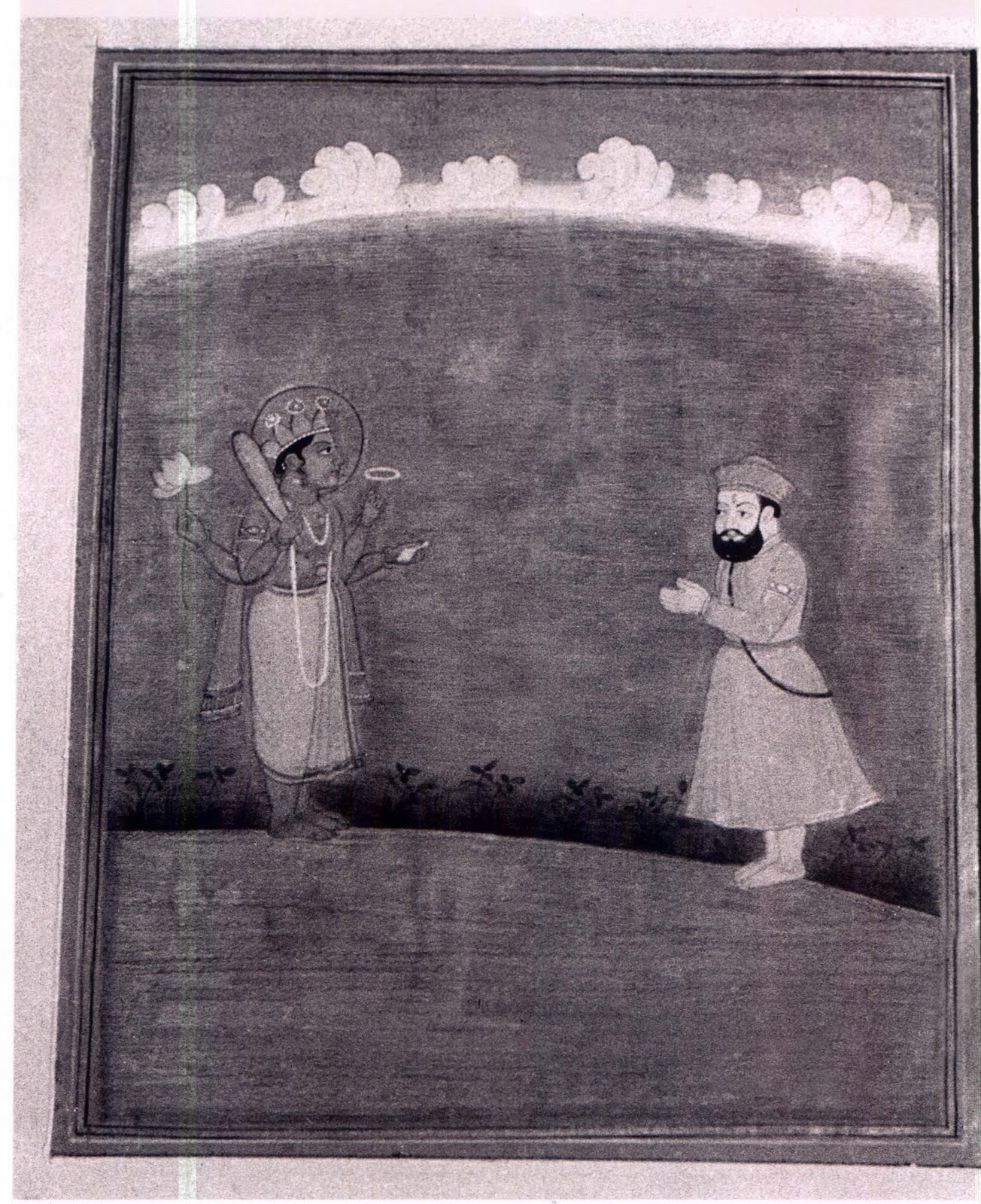
Read this:

http://1.bp.blogspot.com/_E4B5IWmQ8pU/TC3p6YuAlxI/AAAAAAAAABY/ErSTuCtbGqQ/s1600/picture.JPG

In contemporary devotional pictures and posters of Guru Nanak (1469-1539), as seen in taxis and shops, the Guru is invariably shown as wearing a pagari or turban, like his pupils (Sikh-s) today. But this is a recently-imposed convention, not followed in his own day and in subsequent centuries.

In traditional paintings, the Gurus never wore turbans, a custom that even according to Sikh teaching itself was only instituted by the tenth and last Guru, Govind Singh, in 1699. All the Gurus are typically shown as wearing a topi (Hindu-style cap) and patka (sash). We discuss one instance.

K.C. Aryan (born 11 August 1919, died 2002), a Partition refugee from West Panjab, was an accomplished painter. He founded the Museum for Tribal and Folk Art in Gurgaon, still functioning today. He saved plenty of old paintings, sculptures and other arts & crafts objects for posterity by collecting them in his museum or donating them to more established institutions.

In 1970, he presented to the publishing unit of Punjabi University Patiala a manuscript with illustrations for a book, 100 Years Survey of Panjab Painting (1841-1941). It was eventually published by the PUP in 1975, but only in mutilated form. The Senate Board of the University objected to the inclusion of one particular painting, and threatened that if it were published, the grant for the whole publishing unit would be stopped.

The contentious painting, executed by a Pahari painter in the mid-19th century (whose name, as often in folk art, remains unknown), shows a topi-wearing Guru Nanak praying to Lord Vishnu. The Board took the Sikh-separatist line that that Sikhism has nothing to do with Hinduism, and that the Gurus are above the ?Brahminical? gods. It is the same line that keeps the Sikh establishment from calling their central shrine, the Hari Mandir (?Vishnu temple?), by its proper name, hiding it behind the superficial designation ?Golden Temple? or the Moghul term ?Darbar Sahib?. It is also why in 1922 they threw out from the Hari Mandir the murti-s that had been worshipped there ever since Arjan Dev inaugurated it in 1604. Sikh identity as a separate religion, rather than as one of the many panth-s in the Hindu commonwealth, is based on a denial of history, and this requires a constant censoring of unwilling historical data: names changed, scriptures doctored, murti-s thrown away, the publication of a painting suppressed.

K.C. Aryan donated the painting in ca. 1982 to the Himachal State Museum in Shimla. There, it is significantly not on display but kept in storage. That is, if it has not been lost or illegally sold by some babu unconcerned with art and heritage; or somehow eliminated by one with Khalistani.leanings eager to destroy the evidence for an inconvenient fact: that Guru Nanak was every inch a Hindu.

The Sadhus at the Krishna Bhakti ashram that were exploiting the naive Australian seeker and were always high on drugs.

Countless ashrams all over India financially, emotionally and sexually exploit naive seekers in the name of ‘Karma Yoga’ Seekers work free for them in exchange for nothing for substandard food and substandard living conditions. The Australian seeker friend was badly exploited by the Sadhus who ran the ashram. They made him do everything, cook and clean for them, clean even their own plates, run errands and get groceries, and even asked him to pay rent and pay for their groceries in the name of ‘Karma Yoga’ They spat him out like used chewing gum after he ran out of money(they spent all his money!) None of this hard work meant anything.
The conditions we were living in the ashram were filthy. There were rats running around in the kitchen, bedsheets had not been cleaned in years.

I had witnessed similar conditions at all the ashrams in India, even the prestigious ones. At Parmath Niketan Ashram Rishikesh, the biggest and most powerful ashram there, and it is clear they have a lot of money to spend because the ashram complex is beautiful and grande, but they have spent next to nothing on the accommodation for seekers. The living quarters are like prison cells and in horrible condition. This is stark contrast to the head Swami who has his own private helicopter. The ashram is run like a business. It doubles up as a hotel for tourists. They offer substandard Yoga, meditation and Vedanta classes only when it is ‘season’ this basically means when the foreigners start to come to India. At other periods such as when Indian pilgrims come, even though their numbers are substantially more, this is considered ‘off season’ As I look Indian, I was turned away rudely with, “No, classes right now, come another time” I then found out classes were actually being arranged for the foreigners staying there.

Consistently you will see that the living quarters of the gurus to be palatial in contrast to the living quarters of seekers. At two Ashrams I went to, the head guru even had a television in his room, and I would constantly catch them watching television when I came. They did nothing the whole day but lounge in their room like a couch potato. Seekers who came to them were often dismissed or processed.

I cannot read the text because the image you have posted is spoiling the frames of the screen. Please remove the image because it is spoiling the frames of the thread.

I have contacted David. I can’t remove it anymore, because the edit-
buttom has also gone out of the frame.

I have contacted David, but meanwhile, you can copy the text
and past it in word.