
I cannot read the text because the image you have posted is spoiling the frames of the screen. Please remove the image because it is spoiling the frames of the thread.
I have contacted David. I can’t remove it anymore, because the edit-
buttom has also gone out of the frame.
I have contacted David, but meanwhile, you can copy the text
and past it in word.
I share your sentiment about the fake gurus and business ashrams. This is a big problem in Hinduism. I have also criticised these type of ashrams and gurus many times before. But if we want to make a difference, we should not turn our backs to India and Hinduism. Greedy people are abusing Hinduism and if we turn our backs, we are letting them win. I am not telling you to look only at the good side and close your eyes for the bad. The only reason to criticise the bad is because you care deeply about Hinduism and India, not because you think they are dead to you. Your dissapointment after some of your encounters are understandable, but your dismissal of the diverse traditions within Hinduism as a whole is simply misguided anger.
It is difficult reading posts now. I recommend that we shorten
the space of each post as I have done for this.
The problem is fake gurus and business ashrams is not a small
problem, it is wide spread throughout Hinduism today. As I said
Hinduism is a culture steeped in superstition, dead traditions and
blind faith today. We must recognize the root of this, and I unfortunate
to say it is the diversity that is the problem.
Why do you automatically take diversity to be a good thing? Is it not
this diversity in the first place why India was ravaged by invasions
Isn’t this diversity the reason why so many people are confused about
Hinduism? Isn’t this diversity the reason why India never had an industrial
and scientific revolution like Europe and Middle East had?
Why endorse something which only leads to degeneration? It is apparent
looking at the history of Hinduism that the tendency towards degeneration
into ritualism has been opposed by all enlightened people, Buddha, Guru
Nanak, Adisankara. Are you saying they are not enlightened now?
Historically, Sikh tradition may have been tolerant of Hindu idolatry, but that
does not change the fact that many of the sayings and stories we have of
Guru Nanak oppose the spirit of idolatry and superstition. Guru Nanak advocated
the worship of Nirguna Brahman through naam-simran(chanting the holy name)
He did not say go to mandirs and pray to idols. He actively campaigned against
many of the dead traditions of Hinduism and opposed its rituals like the Buddha
did. This is historical fact, why oppose it?
The above article was from Dr Koenraad Elst. I have more readings for you from Koenraad Elst about monotheism and the Arya Samaj. This is going to be a multi part series and only the introduction and the first part has been published yet.
The occasion for this paper on monotheism and its presence or absence in Hinduism is an upsurge in the Arya Samaj’s long-standing campaign to convince Hindus of the superiority and Vedic basis of monotheism.
Founded in 1875, the ?rya Sam?j, in effect “Society of Vedicists”, was a trail-blazer of Hindu revivalism and anti-colonial nationalism until Independence. It worked bravely for the reconversion of Indian Muslims, the only humane solution to India’s communal problem. Some of its spokesmen gave their lives for speaking out on Islam, most notably Pandit Lekhram in 1897 and Swami Shraddahananda (co-founder of the Hindu Mahasabha) in 1926. The Arya Samaj also led the way in the abolition of caste discrimination and the acceptance of widow remarriage, both as a matter of Vedic principle and in order to free Hindu society of its weaknesses which its enemies were exploiting to their advantage.
Unfortunately, in its opposition to the predatory religions of Islam and Christianity, it interiorized some of their beliefs and attitudes. Foremost among these was the assumption that monotheism, the belief in a single God annex the condemnation of all worship offered to any being but Him, is the supreme form of religion. Hence, the Arya Samaj decreed that the Vedic religion had always been monotheistic, so that Islamic and Christian missionaries had nothing to teach the Vedicists about the true religion of the One God. If Hinduism now seemed like the polytheistic religion par excellence, this was partly due to post-Vedic degenerative developments and partly to textual misinterpretation of the seemingly numerous god-names in the Vedas. In reality, or so the Arya Samaj claimed, these many gods were only different faces of the One God.
Until Independence (completed by the struggle against the Nizam of Hyderabad for Hyderabad’s accesion to the Indian Union in 1948, in which the later Arya Samaj president Vandematharam Ramachandra Rao took a leadership role), this monotheistic reinterpretation of the Vedas could be excused as a tactical device useful in the Arya Samaj’s main struggle, viz. against the predatory monotheistic religions. Ever since, however, and especially in the recentmost decades, the Arya Samaj seems to have forgotten its original mission, and is now turning the bulk of its polemics against fellow Hindus who have not embraced this monotheistic reading of the Vedas. In effect, the Arya Samaj has become Christianity’s and Islam’s first line of attack against Hindu polytheism.
As an organization, the Arya Samaj is no longer very powerful or important, but its message has spread far and wide in educated Hindu society. The same is even more true of a similar movement, the Brahmo Samaj (?1825), a flagbearer of the Bengal Renaissance which tried to translate Hinduism into rational-sounding concepts acceptable to the British colonizers and the first circles of anglicized Hindus. Whereas the Arya Samaj embraced a Christian-like religious theism, the Brahmo Samaj tended more towards a modern Enlightenment-inspired deism, i.e. the philosophical acceptance of a distant cosmic intelligence rather than a personal God biddable by human imprecations and sacrifices. But like the Aryas, the Brahmos rejected Hindu polytheism as a degenerate aberration from the true Vedic spirit.
In the course of the 20th century, the Arya and Brahmo views of Hindu tradition have become mainstream among English-speaking Hindus. Many introductory textbooks on Hinduism used in India, and most of those used in NRI-PIO circles, deny Hindu polytheism and insist that the many Hindu gods are merely faces of the One God. Thus, among the textbook edits proposed by two Hindu foundations that triggered the California textbook controversy of 2005-2009, a prominent one was the replacement of “gods” with “God”.
Before entering the specifics of the monotheism argument, let us say beforehand that we don’t believe the contents of this argument have been decisive in the Arya Samaj’s prioritizing the struggle against polytheism nor in its abandonment of its original alertness against Islamic and Christian aggression. On both issues, the organization is simply riding with the tide. Now that Nehruvian “secularism” has become the norm, it is just not done to criticize Christianity or Islam (except by the brave) or to describe their conversion offensive as a problem. The Arya Samaj has abandoned its own raison d’?tre. We may not be able to counter anyone’s opportunistic reasons for being on the safe side of an existing trend; but we are in a position to refute the theological justification which the Arya Samaj proclaims for its adoption of “Vedic monotheism”.
In this article series, we will consider (1) the genesis of monotheism; (2) Christian and post-Christian attempts to discover monotheism in Zoroastrianism, Buddhism and tribal religions; (3) Hindu or Arya attempts to discover monotheism behind “apparent” Hindu polytheism; (4) the related issue of ”idolatry” and the Arya campaign to extirpate it from Hinduism; (5) the logical ways for Hindus to deal with the monotheistic challenge. We may take up questions (welcome at koenraadelst@hotmail.com or at the present forum) in a final article.
Monotheism is not merely the cult of a single god, which would be called henotheism, but also implies the active rejection of all other gods. The recipient of monotheistic worship is not Heis Theos, “one god”, but Ho Monos Theos, “the only god”. Thus, Hindus worshipping an ishta devata, “chosen deity”, selected from among many, are henotheists but not monotheists. A Hindu who never worships any god except Shiva, but doesn’t object to his neighbour’s worshipping Krishna or Durga, fails the test of monotheism.
1.1. Akhenaten’s solar monotheism
At the present state of knowledge, the first recorded monotheist was Pharaoh Akhenaten or Ekhnaton (r. 1351-1334 BC). He not only worshipped a single god, the solar disc Aten, but also tried to terminate the worship of other gods, starting with the removal of Amon from his own original name Amenhotep (“Amon is satisfied”), which he replaced with Akhen-Aten (“Living spirit of Aten”). Later, his son would make the reverse movement, changing his own name from Tut-ankh-Aten (“Living image of Aten”) to Tut-ankh-Amon. Akhenaten’s monotheism didn’t survive him for long because it went against the grain of Egyptian culture and sensibilities.
Perhaps he could have made people accept his religion sincerely if he had at least combined it with political successes and prosperity. In his own new capital Akhet-Aten (“Horizon of the Aten”, Amarna) he concentrated a community of followers that enjoyed privileges provided for from the state treasury, which means the rest of the people had to subsidize his socio-religious experiment. His foreign policy was a disaster, he neglected diplomacy and military fortifications and thus greatly weakened his empire. After his death, the Egyptians tried to quickly forget him.
Akhenaten’s present popularity, attested by his enormous overrepresentation in textbooks on ancient Egypt, is a consequence of the plentiful and innovative artworks depicting him, his chief wife Nefertiti and his Aten cult; and mostly of his monotheism, deemed uniquely meritorious. Since Moses, the founder of Israelite monotheism, lived in Egypt about a generation after Akhenaten, it is widely assumed the Pharaoh influenced the Prophet.
1.2. Moses’ monotheism
Moses found his One God when he was living in the desert as a guest of Jethro, the priest of the Beduins of Midian (Exodus 2:15 ff.), a region in the northwestern corner of Arabia where he had fled to as a fugitive from Egyptian criminal justice, wanted for manslaughter. He experienced an audio-visual sensation while looking into a burning bush, a desert plant from which an ethereal oil evaporates that catches fire in the noontime heat. A voice told him to take off his shoes as he was standing on hallowed ground, i.e. in the presence of a divine being. The god, when asked by Moses for his name, introduced himself as “I am that I am” (eheyeh asher eheyeh). Biblically, this is understood as a hint at the name Yahweh, interpreted through approximative folk etymology as “the Being One”, “the One Who Is”; or by later exegetes with airs of profundity, as “the One Whose Essence is Being”.
In fact, as the great Orientalist Julius Wellhausen has shown, the name Yahweh is Arabic (its root is attested in the Quran) and means “the Blower”, apparently the Beduin god of wind and storm. Egypt’s Nile Valley has an extremely stable climate with endless sunshine, but the desert is subjected to sand storms, hence the logic of Moses’ replacing the Pharaoh’s sun god with a storm god.
After having fallen from grace in Egypt, Moses fashioned himself a new career as the national leader of the Semitic immigrant population in Egypt, which he led away to Palestine. Along the way, in the wilderness of Sinai, he staged a show with smoke and trumpets and had the gullible people believe that he had seen God on the mountain and received the Ten Commandments from Him. These consist of two unrelated parts. The second part is age-old general morality of the “thou shalt not kill” and “thou shalt not commit adultery” type. Of course people don’t need a divine revelation to know that societies couldn’t function for long without such a set of basic rules. Other nations didn’t bring God in and called these rules the mos maiorum, “the ancestral customs”, tried and tested by ages of practice. In this case, however, they were tagged on as a second half to the first set of commandments, which by contrast went completely against the tradition. Rendered more acceptable by the coupling with indisputable rules of morality, this first part was quite revolutionary, viz. Moses’ new theology. This included a prohibition on using God’s name lightly (a taboo also found in other religions), on making images of God, and most of all, on offering worship to any god beside Yahweh.
The first thing Moses did when he came down from the Sinai mountain with his rock-hewn Ten Commandments was to slaughter 3000 religious dissenters. These were enthusiasts of Ba’al, “Lord”, originally a generic term of address for kings and gods, later used specifically for the Northwest-Semitic fertility god Hadad. He is known from Semitic royal names like Jeze-bel, Bel-shazzar, Hanni-bal and Bal-thazar. This traditional fertility god was typically depicted as a bull. For the purposes of worship, the devotees in the Sinai had fashioned a statue (what Hindus call a m?rti) of the bull god from their own jewelry: the “Golden Calf”.
Nowadays this term is used as shorthand for crass materialism and greed, as if this moral vice were needed to justify the devotees’ mass slaughter by Moses. In fact, they were anything but greedy, they donated their wealth in exchange for the joy of having a focus for their religious exercise of worshipping Ba’al. It was not because of a moral vice that they were put to death, but only because they worshipped another god than Yahweh. The latter could not tolerate this since he was, in his own words (as reported from Mount Sinai by Moses), “a jealous god”.
Moses did not live to see the conquest of the Promised Land, of which he only caught a glimpse from afar. His successor Joshua devised a clever strategy of keeping the non-combatants concentrated outside the war zone and attacking the cities one by one. Citing orders from God, he eliminated the native fellow-Semitic population, the Canaanites. This he justified with a promise which he claimed Yahweh had made long before (scholars’ estimate: 4 to 5 centuries) to the patriarchs Abraham, Isaac and Jacob. Note that the natives were not asked for their theological opinions. They were not killed because of their polytheism, and it seems unlikely that they could have saved themselves by quickly converting. At that time, Yahweh was still the god of a nation, not of a community of like-minded believers.
1.3. Henotheistic origins
It is widely assumed among scholars that the Yahweh cult was initially henotheistic rather than monotheistic. Yahweh insisted that his followers worship only him and no other gods, but this did not immediately imply that other gods were deemed non-existent and illusory. “Thou shalt have no other gods before me”, the first of the Ten Commandments, can be read as a husband’s claim on the absolute loyalty of his wife. By no means does such a husband deny the existence of other men, he merely demands that his wife disregard all other men and devote herself exclusively to him. In the initial phase, Yahweh’s religion makes no truth claim about the non-existence of other gods, rather it sees them as dangerous seducers who have to be kept at bay. From the 13th to the 7th century BC, Israelite monotheism was in a formative stage of a henotheism increasingly hyperfocused on the chosen One God, leading to the ultimate black-out of the other gods. From seductive rivals to Yahweh, they shrivel to become illusory projections of the human mind.
This evolution is summarily acted out in the evolution of the Biblical god’s other name, Elohim. In Northwest-Semitic (Canaanite, Ugaritic, Phoenician, Hebrew), this is a masculine plural form, meaning “gods”. The Semites had a god El, whose name lives on in personal names like Gabr-i-el, “my strength is God”, Mi-cha-el, “who is like God?”. In cuneiform, this name was rendered with the sumerogram Dingir, showing a star. That indeed is the original West-Asian concept of the gods: they were stars, collectively “the heavenly host”. One of the oldest epithets of Yahweh is “Lord of Hosts”, i.e. the supergod presiding over the army of gods in their daily march across the sky (which again presupposes that the other gods were real, though lesser in stature). The contrast between polytheism and the first monotheism was quite literally that between the numerous stars in the night sky and the lone star of the day sky.
A noun derived from El is the feminine abstractive noun Eloha, “a god”, “deity”, better known in its Arabic form Il?ha. This countable noun referred to any of the numerous gods worshipped by the Pagan Arabs. With the South-Semitic definite article al-, this becomes Al-Il?ha, “the god”, better known in its contracted form All?h. Both in Hebrew Elohim and in Arabic All?h, we see how the conception of the One and Only God, to judge from his name, is rooted in the polytheistic conception of “god” as a countable noun, “one of the gods”. As if a single star was selected, looked at ever more closely until it outshone and rendered invisible all other stars, and was then reinterpreted as the only star in existence.
This rootedness in polytheism is found in most languages where the concept of a single God was introduced. To the pre-existing Greek and Latin generic terms theos and deus, “a god”, the emerging Christian Church assigned the new monotheistic meaning “God”. In Germanic, the word god seems to have been a uncountable noun since pre-Christian times, but of neutral (rather than of masculine) gender, i.e. impersonal: “the numinous”, “the divine”. Its Sanskrit etymological equivalent is hutam, “(that which is) honoured with libations/sacrifices”, “(that which is) worshipped”. Here too, the Christian monotheistic term is borrowed from a pre-Christian non-monotheistic conception, viz. of the divine as a numinous essence present in an undefined number of gods and perfectly thinkable apart from a single personal God. In Chinese, Protestant missionaries have chosen the old term Shangdi as their translation of the Biblical names for “God”. They may not have realized that in Chinese, which doesn’t morphologically distinguish plural from singular, this ancient term had been conceived as plural: “the powers on high”, “the gods above”.
In the 19th century, the idea of an Urmonotheismus, a primeval monotheism, gained ground. It meant that the historically attested polytheistic religions had come into being as aberrations from an older monotheistic religion. Islam had pioneered this idea with its claim that Adam had been the first Muslim and that the Kaaba, built by Adam, had later been usurped by the Pagans for the polytheistic worship which Mohammed found (and destroyed) there. But in the actual history of early monotheism, we find its cradle was polytheistic, with no trace of a reference to an earlier, primeval monotheism.
1.4. The jealous God
In polytheistic pantheons, gods with a specific character are typically counterbalanced by gods with the opposite character, e.g. war-like Ares or Mars with harmony-seeking Aphrodite or Venus. No doubt the Arab Beduin storm-god Yahweh had brothers and sisters in the pantheon who represented less stormy traits to keep the whole in balance. If the idea of a single god had been thought up in the abstract, one could have expected him to be neutral, elevated far above all those pairs of opposition. Later thinkers working within a monotheistic framework will indeed try to understand their god in this manner: as a coincidentia oppositorum, “unity of opposites” (thus German philosopher Nicolaus Cusanus, 15th cent.). Instead of a war-god held in check by a peace goddess, you would logically get a single god transcending the war/peace opposition.
However, that is not how monotheism originally came about. When all other gods were outlawed, Yahweh nonetheless retained his character of tribal storm god, but no longer counterbalanced by more pleasant fellow-deities. Though not as sexually playful as the Indo-European storm-gods Indra, Zeus, Jupiter, Perkunas, Perun or Donar (unless you include his begetting Jesus upon the Virgin Mary, and even that fling on the side he outsourced to the Holy Ghost), Yahweh resembles and outdoes them in choleric flare-ups and violent discharges of anger. Thus, his initiative to destroy mankind by means of the Flood was motivated by anger at the disappointing performance of his own human creatures.
Let Yahweh’s short temper be his privilege and that of his followers, the one thing truly objectionable about him from the viewpoint of the non-believers is only his effort to destroy alternative gods and their religions. Pre-Christian Israelite history is punctuated by episodes of slaughter against non-Yahwists. Thus, the prophet Elijah challenged a group of Ba’al priests to have their god produce a miracle and set fire to a sacrificial animal. Of course miracles don’t exist, so nothing happened; and when Elijah had Yahweh set alight his own sacrifice after he had sprinkled “water” on it, the gullible were taken in, but he had obviously used a trick (petrol?). At any rate, the next thing we know is that he had the 450 Ba’al priests put to death. His own disciple Elisha organized a coup against the Ba’al-worshipping queen Jezebel and killed her and 70 of her relatives.
However, until the expansion of Christianity, this campaign of destruction was limited to the Israelites or such foreigners as lived among the Israelites and had an influence on them. It did not interfere with the religion of “the nations”. To be sure, there was plenty of slaughter of non-Israelites during the conquest of the Promised Land. But this was simply to make way for the Chosen People, to create living space, not to make them change their religion. On the contrary, it was taken for granted that “the nations” (ha-goyim) had other religions than that of Yahweh: “And when you look up to the sky and see the sun, the moon and the stars – all the heavenly array – do not be enticed into bowing down to them and worshiping things the Lord your God has apportioned to all the nations under heaven.” (Deuteronomy 4:19)
You’ve read that right: the heavenly hosts as the gods forbidden to the Israelites, have been “apportioned to all the nations” by Yahweh, who consequently didn’t want them to worship him instead of the gods given to them. This again testifies to the fact that Yahweh was originally conceived as a tribal god, entitled to the loyalty of his own tribe but without universal pretentions (just as a husband is entitled to his wife’s loyalty but not to that of all women).
The first dim apparition of Yahweh’s universal ambition is perhaps Prophet Isaiah’s fantasy of an end-time in which all nations come to pay tribute to the Israelites and their god in Jerusalem. But it is only later, in the multicultural and universalizing climate of the Hellenistic states (4th-1st cent. BC) and the Roman Empire, that some Israelites start conceiving of their God as universally valid. This didn’t make them embark on massive missionary campaigns, but on a small scale they did start to attract converts or “proselytes”. Jewish thinkers like Philo of Alexandria briefly tried to incorporate notions from Greek philosophy, such as Plato’s “idea of the Good” or Aristotle’s “unmoved mover”, into their conception of God.
It fell to Christianity to complete this job of incorporating the universalist Greek concepts of the Absolute into the monotheistic construction of God. Because Christianity had universal rather than national ambitions, it made the destruction of everyone else’s “false gods” its chief mission. This same mission was later interiorized and amplified by Mohammed. To the surviving non-monotheistic traditions, monotheism became an all-devouring predator and a self-declared enemy.
Since I am not a follower of the Buddha, Shankara or guru Nanak
and the question of whether they were enlightened leaves me cold
These personalities did became icons in reformist groups, but
not because of their ideologies. They were simply used as icons in
reformist groups, nothing more, nothing less.
A lot of misconceptions have been spread about early buddhism by
buddhist reformers, like Ambedkar. Similarly, misconceptions about
Shankaracharya’s advaita have been spread by Vivekananda and the
Sikh seperatist groups have tried to break all ties of Hindu-Sikh
relationships.
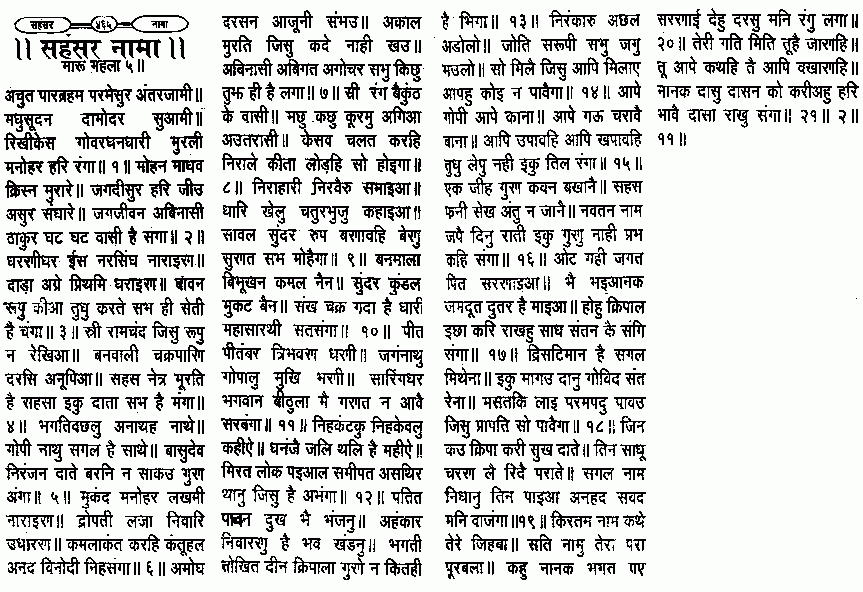
As you can read in the above post. Arjan Dev, the fifth sikh guru
installed Murtis in the Hari Mandir in 1604 (vishnu’s temple). These were
later removed by the Sikh seperatists in 1922.
In Arjan’s Dev’s Sundar Gutka, he included the 1000 names of Hari, in a
similar style like the Vishnu Sahasranama from the Mahabharata.
Namakirtana is by definition not nirguna upasana.
You can read them here:
In the beginning Sikhism was simply a branch of vaishnavism,
one of the many paths within Hinduism. Later, more and more
influence from Islam started to creep in.
[QUOTE
Can you imagine, Surya Deva walking up to a Sadhu.
SD: Yo dude, I want to be just like you.
Sadhu: Okay man, do what I have done and renounce the world…
SD: No way man, I am out of here…
[/QUOTE]
When the Guru was dying, one of his deciples asked him "Guruji, who was your master?"
He said, "I had thousands of masters. If I just relate their names it will take months, years and it is too late. But three masters I will certainly tell you about. "
"One was a thief. Once I got lost in the desert, and when I reached a village it was very late, everything was closed. But at last I found one man who was trying to make a hole in the wall of a house. I asked him where I could stay and he said ‘At this time of night it will be difficult, but you can stay with me - if you can stay with a thief’.
And the man was so beautiful. I stayed for one month! And each night he would say to me, 'Now I am going to my work. You rest, you pray.'
When he came back I would ask 'Could you get anything?'
He would say, ‘Not tonight. But tomorrow I will try again, God willing.’ He was never in a state of hopelessness, he was always happy. When I was meditating and meditating for years on end and nothing was happening, many times the moment came when I was so desperate, so hopeless,that I thought to stop all this nonsense. And suddenly I would remember the thief who would say every night, 'God willing, tomorrow it is going to happen."
“And my second master was a dog. I was going to the river, thirsty and a dog came. He was also thirsty. He looked into the river, he saw another dog there – his own image – and became afraid. He would bark and run away, but his thirst was so much that he would come back. Finally, despite his fear, he just jumped into the water, and the image disappeared. And I knew that a message had come to me from God: one has to jump in spite of all fears.”
“And the third master was a small child. I entered a town and a child was carrying a lit candle. He was going to the temple to put the candle there.'
I asked the boy in jest , 'Have you lit the candle yourself?'
He said, 'Yes sir.'
And I asked, 'There was a moment when the candle was unlit, then there was a moment when the candle was lit. Can you show me the source from which the light came?'
And the boy laughed, blew out the candle, and said, 'Now you have seen the light going. Where has it gone? You tell me!'
My ego was shattered, my whole knowledge was shattered. And that moment I felt my own stupidity. Since then I dropped all my knowledgeability.”
“It is true that I had no master. That does not mean that I was not a disciple – I accepted the whole existence as my master. My Disciplehood was a greater involvement than yours is. I trusted the clouds, the trees. I trusted existence as such. I had no master because I had millions of masters I learned from every possible source. To be a disciple is a must on the path. What does it mean to be a disciple? It means to be able to learn. to be available to learn to be vulnerable to existence. With a master you start learning to learn.”
The master is a swimming pool where you can learn how to swim. Once you have learned, all the oceans are yours.
Sorry for the delay fixing the thread. Thanks for contacting me Sarvamaṅgalamaṅgalā.
A Hindu who never worships any god except Shiva, but doesn’t object to his neighbour’s worshipping Krishna or Durga, fails the test of monotheism.
A Shiva worshiper does not object to a Krishna or Durga worshipper, because he understands they are worshiping the same god. Most Hindus you talk to will tell you there is only one god, but infinite are his forms. This is hardly just a modern Neo-Vedanta tack on or a response to Christian monotheism, it is as old as the Vedas, “There is only one supreme truth, with many names like Indra, Varuna, Aryaman” “There is only one without a second, not two or three, four or five, six or seven” “In the beginning there was only one, and nothing else”
In classical Vedanta of the Upanishads this ONE is called Brahman. The supreme, infinite, absolute reality. There can only be one infinite. Multiplicity is explained as Brahman appearing in infinite forms in reality through the power of maya. Hence the concept of Nirguna Brahman and Sadguna Brahman; Brahman without attributes and qualities and Brahman conceptualized by humans as having attributes and qualities(Brahman as the divine architect, Vishvakarma; Brahman as the fire divine, Agni; Brahman as the supreme lord, Indra; Brahman as the vital force, Vayu) Vedanta enjoins one to directly worship, meditate and contemplate on Nirguna Brahman. In the Chandogya Upanishad when a sage approaches King Janaka with instructions on meditation, the sage tells him to meditate on various forms such as light, wind etc, King Janaka keeps falsifying him, “No, one should not meditate on light, but should meditate on the principle of luminosity, the supreme light of Brahman” Whatever Sadguna Brahman the sage tells, Janaka falsifies it with the Nirguna Brahman.
In principle it is recognized in Hinduism that worshipping Sadguna Brahman is considered an inferior practice(Swami Vivekananda, Sri Aurobindo echo the same) because effectively you are worshiping only human imagination. Even the Agamas recognize this is an inferior practice, brought on by Kaliyuga, where people’s intellect is too unrefined to work with Nirguna Brahman. Guru Nanak reformed Hinduism to form Sikhism by getting rid of Sadguna Brahman worship and replacing it with Nirguna Brahman. This is why in the famous Mool Mantra of the Sikhs we find:
Ek Onkar: There is only supreme reality
Sat Naam: He is the true name
Karta Purka: He is the supreme creator
Nir Bahu: He is fearless
Nir vair: He is without discrimination
Akal Murat: He is absolutely formless and timeless
Ajuni: He is beyond birth and death
Sai Bhang: He is self-existent
Gur Purshad: He is realized by the true guru’s grace
Jap: Mediate on his name
Aad Sach: He was true in the timeless beginning
Jagad Sach: He is true through the ages
Hai Bhi Sach: He is true now
Nanak Hosi Bhi Sack: Nanak says, he will always be true
All practicing Sikhs chant this mantra everyday. It is thus clear that Sikhism does not at all endorse idolatry. It is fundamentally opposed to the spirit of it. Very much like classical Vedanta of the Upanishads or Advaita of Sankara is. The practice of creating Sadguna Brahman image is considered completely unnecessary and the practice of the lowest denominator of spiritual seekers, who worship human imagination, mythical creatures. It really is not necessary, because all you need to do is simply remember god(Naam Simran) in your heart. Sit quietly with yourself and dedicate yourself to god. You do not need to go to any temple or erect statues and worship them every day - none of this fanfare and grandiosity is required, moreover it is distracting. Just quietly go within yourself. There god resides.
If somebody tells me they can’t sit quietly and meditate and pray to god, but need to go to a temple and worship statues of gods and goddesses, perform elaborate and complicated rituals to them and consecrate them, then it tells me exactly at what level of spiritual maturity they are at. They are akin to a child’s love for Santa clause. Alas, at least the child actually eventually grows out of it.
Yoga is yoga.
The intention is to wake up and free our minds from suffering. annamaya kosha is first. Asana opens the door for deeper exploration. pranamaya kosha is second , and is more subtle, it cannot be seen but can be felt. manamaya kosha is the third layer, and aligns with the nervous system, and also relates to the mind, thoughts, and emotions. Meditation taps into this space and can help to bring awareness to thought patterns. All of these layers can be penetrated simultaneously, and is a beautiful process of self ultimately reveals ?
The tradition that Sarva follows is known as Vaishnavism(Vishnu-centered tradition) who worship the supreme personality/godhead in the form of Vishnu, Krishna, Narayana. Most Hindus today are Vaishnavists. Most Vaishnavists are dualists, in that they believe that the world, god and soul are all real and separate from one another(known as tattvavada, the philosophy of reality) This is stark contrast to the Upanishadic Advaita, which believe that the world, god and soul are ultimately unreal, simply forms or manifestations of the ultimate reality of Brahman(The philosophy I subscribe to)
According to to Vaishnavists god has a supreme form and he is the source of all glorious qualities and virtues. He is perfect, only one, par excellence and none can parallel him.
While many Vaishnavists consider god as having no human form or particular name, the Gaudiya Vaishnavists consider god to literally be Krishna, have his form and his names. Thus they oppose any other description or name of him(e.g., Shiva, or Jehova, or Allah)
There are some Vaishnavists who consider themselves one with god or god themselves, but they are a minority viewpoint and not representative of Vaishnavism as a whole. Most Vaishnavists see god as a completely separate entity and sovereign of the world and souls. This supreme godhead is controlling everything in the world, every atom and every soul(Hence he is known as Antaryamin(inner controller) too) Thus nothing is in our individual control, no amount of personal effort made by us is enough for us to attain salvation. Salvation can only be WON through’s god’s grace.
To win god’s grace one must serve him, please him and worship him constantly. At the same time they must perform service to the world and other souls in the world, perform all their duties selflessly. If god is pleased with the soul, then god will reward that soul by granting them entry into heaven(Vaikuntha) and there the soul will be given the privilege to be in eternal servitude to god(sounds great, can’t wait :P) It gets better, there will a gradation in which level of heaven one would enter, based on the soul itself. This is not based on their merit(karma), but on the intrinsic qualities of the soul. If the soul was originally tamasic, it will enter the lower levels; rajasic, it will enter the intermediate levels and sattvic, it will enter the higher levels. There is no scope for any mobility here between levels, you are stuck at the level you are predestined for.
For souls that displease god there is a more morbid future awaiting: eternal damnation. Where the soul enters one of the 7 hells where it is subjected to endless torture.
I can hear people say, 'Hang on, is that Hinduism or some Abrahamic religion?" Unfortunately, it is Hinduism. In fact it is the most popular form of Hinduism today. Most Hindus believe in this Puranic form of Hinduism. In the Garuda Purana you will find extensive descriptions of the kind of torture that we are subjected to in hell for displeasing god. In other Puranas you will find extensive descriptions of the 7 heavens and the beings who populated them, the fun and frolics, the heavenly nymphs dancing to please men, as if straight out of an Islamic scripture.
If you examine Puranic Hinduism you will find the same dogma, nonsense, fairy tales, superstitions and unscientific theologies to give any Abrahamic religionist a run for his money. The description of Puranic astronomy for example makes Christian flat earthers look a little sensible:
This of course has got nothing to do with the original Santana Dharma of the Vedas. As I demonstrated earlier, the original Sanatana dharma is a religion of spiritual humanism which promotes spiritual development, social development and scientific development. It has no place for the garbage of Puranic Hinduism.
[B]Refuting Madhvacharya[/B]
Madhvacharya is a key philosopher of Vasihnavism, and this thinking is used by many Vaishnava thinkers to justify their doctrines. He was the first Hindu philosopher to create an Abrahamic like theology: An absolute and all powerful monotheistic monarch god, that creates etc the universe, that is served by a hierarchy of spiritual beings(like anglels) that resides in heaven(Vaikunta) that grants eternal salvation to souls that please him and eternally damnation to souls that displease him.
In this post I am going to refute the philosophy of Madvacharya as described here: http://www.tatvavada.org/eng/
[B]The Supremacy of Lord Vishnu[/B]
Madhvacharya recognizes that no single name can be used to denote god, but a special preference is given to the name ‘Vishnu’ or ‘Narayana’ because they sum up the meaning of god as being the repository of all virtue and glories. According to Madhva Lord Vishnu created this world and conducts the activities of nature and all souls by his free will. The goal of all souls is to recognize his supremacy and worship him to attain salvation.
Refutation: If the lord is the repository of all glories and virtues qualities, then who is the repository of all negative qualities like anger, jealousy, lust, hate? It seems completely arbitrary that only qualities that one recognizes as ‘good’ belong to him, and all qualities we recognize as ‘bad’ belong to something else. Surely, if god is the creator and conducter of the whole universe, then the bad qualities also come from him. In which case god cannot be just all that is good, he also has to be all that is bad.
If god is creating and conducting this universe out of his own free will, for what Vaishnavists call his sport(lila) then such a god can be considered a sadist. As what they consider just play for them, is actually immense suffering for his souls. Why subject them to the torment just for his own entertainment? Such a god must definitely be a sadist.
This god is surely a tyrant. To gain favour with this god one must worship him and then he will grant you grace and entry into heaven - for - eternal servitude to him. In other words the only purpose souls have in this creation is to serve god, else face eternal damnation. Such a god can only be called a tyrant.
Thus we are to conclude that Lord Vishnu is the source of not only just goodness, but evil, and a sadist and a tyrant.
[B]Different souls[/B]
Madhvacharya proclaims that there are infinite souls, each with different qualities of their own. They simply are the way they are because of their intrinsic nature. Like an apple seed can only ever give an apple. In the same way all souls are intrinsically different, none are equal. This is proven in nature that nothing is actually identical, everything is different. It is the difference that maintains the unity of the world. The fact that some souls gain liberation faster than others is because of their intrinsic merit. He also recognizes the soul is not the body, senses or mind. The true ‘I’ is the blissful personality of the soul.
Refutation: The argument that there must be many different souls because everything within nature is different is an invalid comparison and cannot be used to apply to souls as well, because souls are not natural things. The idea that each have their own unique special personality is not tenable, because whatever they have that gives them a unique personality is owing to different senses, bodies and minds. If the soul is not the the senses, bodies and minds, then there is nothing which can give it a personality. Therefore all souls must be exactly identical.
There are some major contradictions in the Madhva’s philosophy on the whole. One one hand it says that god is the supreme sovereign who is controlling everything(including the souls) and the other hand this same god is granting grace and punishing the souls for pleasing or displeasing him. But if he is the controller of everything, then he made the souls do acts to please and displease him in the first place. So how can they be held accountable for those acts? These souls seem to have no free will at all. They are mere pieces in a game of chess played by only one player: god.
It is easy to see simply how ridiculous and absurd it is to believe in a personal god like Lord Vishnu. This is why such kind of monotheistic beliefs in a personal god has historically never been a part of the Vedic religion. Most Vedic philosophical schools are atheist.
Here is an Abrahamic argument by Muslim scholar Dr Zakir Naik against idol worship and the arguments of Hindus to support the practice:
The Hindu argument is that although they know that idol worship is an inferior practice, it is considered necessary at lower levels of consciousness. At higher levels one can lose the idol. This is literally setting up Zakir Nail for proclaiming, “In that case, we have already reached higher levels of consciousness and don’t need idols” All Hindus who Zakir Naik have debated regarding this question, have been rendered speechless on this topic. Why?
Well because of of the very fact that idol worship is not sanctioned in the Vedas or the Gita, but rather is actually condemned. So how can you hold any credibility for practicing something which is not supported by the central scriptures of your own religion, and which is widely considered an inferior practice even within your own religion? Secondly, when the Hindu himself is recognizing it is an inferior practice, why are they practicing it? Why not practice the higher practice to begin with.
Hindus are doing a horrible job representing their religion. They are putting their worst foot forward. They are allowing themselves to be known for idol worship, mythology, bizarre rituals and practices, and millions of gods and goddesses, which includes monkeys and elephants, rather than allowing themselves to be known for their profound philosophy and Yoga. This is why I have chosen to dissociate from Hinduism. Hindus are their own worst enemy and have greatly trivialized the great cosmic and eternal religion they have inherited. This is why they are condemned people.
The original Sanatana dharma, the Aryan religion, did not teach any of the garbage that Hinduism is known for today. The countless stories of Shiva, Vishnu, Devi that fill the Puranic lore are nowhere to be found in the Vedas. They are completely made up stories.
You are no longer Hindu.
Good for you and for the other Hindus:)
Lol, I can see a plague or a flood coming and wiping out the Hindu idolaters a la biblical style 
Some people simply never learn.
Lol, I am posting in this forum after a long time.
At last, our “Columbus” discovered India/Hinduism and trying to run away from it. 
Writing big, big intellectual “fundas” on internet might not help any seeker of Hinduism.
I do not think, it is wise to go to a swim in a sea with suit, trousers and tie on.
Similarly, if you are in India, one need to adopt the appropriate style of life.
Some things that I want to point out:
-
If one wants a true “guru”, then that is oneself. Nowhere in vedas or any scriptures it is said that Guru and student have to be different persons…!!! (as far as I know)
-
In some of his posts earlier in this forum, SD was saying he is “conquering the world” so that it submits to Aryan/Vedic stuff and hence to Hinduism. Same SD, can not come and live for a few days in India. So much for “conquering”…!!!
-
One should not live in delusions. It is some sort of mental disorder. I am giving this advice because, I, myself is inflicted with delusions and taking medicines for the same.
-
Do not be too serious about “Vedic” stuff and neglect your personal life.
-
One cannot be ones own guru, one still needs spiritual guidance and validation externally. I hold a weaker stance now on finding the one and true enlightened master, but mainly because such beings are difficult to find and are outnumbered by fake gurus, that it is a futile to search for them. Thus, one should instead aim to practice spirituality in their life while living actively with other people to get external validation
-
India has got nothing to with being Vedic/Aryan. India is not at all a Vedic or Aryan country today. I have maintained this position even before I went to India, now I just more strongly advocate it. So nothing much has changed other than the intensity of my conviction and my articulation of it.
-
I do not have any delusional disorder. I am considered by most people to be a sensible, sane and level headed person, and some of my friends are mental health professionals. No diagnosis of anything and no prescriptions of medicine. Please do not mistake your situation to be my situation.
-
I am serious about Vedic stuff, because it pertains directly to my personal life and how my life should be lived. I live my life by its central principle of self development.
Thus, one should instead aim to practice spirituality in their life while living actively with other people to get external validation
Yes…it is a form of guru-student concept. Only thing is one may not formally give the “other people” the tag of a guru. The story of Ekalavya is another example.
-
“Vedic/Aryan”, to me is a concept of a set of principles on many fields of human development. If the expectation is that, India should be a country…where everybody breathes Gayatri Mantra and L.K.G kids are taught Yoga and Sanskrit is spoken as a national language…then one may be easily disappointed.
-
If one is really serious about “vedic stuff” and spirituality in general, I think even the western science is coming closer to what vedic knowledge says. It may take some more years of further development…but surely western science is understanding the greatness of “vedic knowledge”.
Some stuff for exploration:
–>Integral OS. This one to me is actually Vedic knowledge even though the speaker gets it from Budhism.
–>Ingo Swann - Human Super Sensitivities and the Future
–> Works of Robet Penrose…esp. shadows of the mind.
- It is the Vedic principles which are important, and not the particular languages and forms you practice. That said if Yoga and Sanskrit was compulsory nationally in India, it would be only beneficial, as Yoga is the best form of mind-body training out there and Sanskrit is the most refined language.
However, ultimately what matters is the principles, and not the language and forms themselves.