I am no longer Hindu

Surya Deva,

I am obviously a newbie, not just here, but to Vedic history/culture/terminology/ philosophy/ theology, and your knowledge of Vedic scripture is VAST and I have very much appreciated reading your posts. Seriously, I going to cut and paste all of this into a text doc for later reading.

Thank you.

Also, I understand your original dilemma; I practiced Soto Zen for several years and at one point I started going to a Sangha with a reputable teacher. However, I started noticing how very neurotic everyone still seemed to be, despite thousands of hour of practice.

For example, I noticed how greedily even the senior members rushed to get into line for interviews with the roshi. I thought to myself “Is this what I’m working towards?”. This is just a small example of the disillusionment that I imagine you felt in India. (I have since left Zen for totally different reasons– another post altogether–but I still read Zen texts regularly.)

All that said, a few thoughts about your trip to India; I’ve never had the good luck to go there yet, but I know from other people the poverty is intense. These people have to fight for very existence. A rich Westerner coming to look for a guru must be like a golden opportunity. All the Vedic knowledge in the world won’t change that contrast… that clash of worlds.

Secondly, have you thought perhaps you were cosmically INTENDED to have these series of negative experiences? If that’s true, then of course, that would be for you to figure out why.

Finally, even if you are 100% correct and Hinduism has devolved into a largely nationalistic/opportunistic/spiritually devolved practice, then that’s what it is. That’s what it MUST be, right now. Much of your criticisms for Hinduism made me think of the criticisms I have for ALL religious institutions, which is a shame, because I would be more than happy join a (almost any) religious community if I thought they were on the right path.

But that’s like asking for the perfect mate in marriage– it doesn’t exist. “They”, “out there” aren’t the problem– one’s own thinking is the true source of the rupture.

Whether one believes the universe is dualistic, or non-dualistic is ultimately just a detail.

All forms of Hinduism– indeed all religions– are flawed. So the question is ultimately a personal one; Do you accept Hinduism with all it’s contradictions and insanity, or would you rather do the Krishnamurti thing and go solo(?) Either path is absolutely valid. But I think it’s important to ask yourself WHY you chose this, or that path.

[QUOTE=ejlorge;72842]
I am obviously a newbie, not just here, but to Vedic history/culture/terminology/ philosophy/ theology, and your knowledge of Vedic scripture is VAST and I have very much appreciated reading your posts. Seriously, I going to cut and paste all of this into a text doc for later reading.

Thank you.

[/QUOTE]

Don’t do that, since you are a newbie, maybe you do not see all the distortions Surya Deva has made in his posts. It is better for you to read a few books, instead of filling your head with the nonsense he has posted.

Namaste Ejlorge,

I think your disillusionment with Zen is similar to my disillusionment with Hinduism, perhaps similar to Krishnamurti’s disillusionment with Theosophy. In fact you will find all genuine spiritual seekers in the past have been disillusioned with the organized religions that existed in their times - Buddha, Socrates, Jesus Christ to name a few. That is because spirituality is something very different from religion. Spirituality is about you and your personal development; Religion is about society, ritual and mythology.

Now Hinduism is a religion that is not really a religion as much as it is spirituality. As you may have seen in my earlier posts the notion of a religion of Hinduism is a modern idea that was created and consolidated by the British. The notion of Hinduism as a geographical thing is an even more recent idea created by Hindu nationalist thinkers in the early 20th century.

To really understand what Hinduism is one must interrogate its history and philosophy and one will find that Hinduism is no religion at all, it is a more a set of general principles, an attitude and a mindset which characterize what we today would call spiritual seekers. Hinduism is something which was founded by spiritual seekers, as opposed to a single prophet or spiritual leader or some religious authority. The oldest texts of Hinduism the Vedas is a collection of poems, writings, personal discoveries of hundreds of different spiritual seekers(risis and sages) The compilation that we know as the Vedas, was the result of these hundreds of different spiritual seekers from across the region of India coming together in assembled and democratically discussing spirituality, sharing their insights, observations, and personal discoveries and finally bringing them together to form what we call the Vedas.

The Vedas contain as we saw in my earlier posts in this thread just general principles and attitudes about spirituality: Some of the main themes are

  1. Knowledge: To know the universe. To grow in wisdom. To penetrate deep into nature to reveal its wonders. To know oneself. To constantly sharpen one intellect, to discern the truth. To meditate, to contemplate, to ponder.

Enhance thy discrimnative power of intellect
And instill the spirit of invincible valour
in thy body
(Yajur 4.11)

He who knows the first vital string
binding all things formed in shape, colour and words
Knows only the physical form of the universe, and knows
very little
But he who goes deeper and perceives the string, the thin
web binding the universe with cords of unity
Knows the ultimate reality
(Atharva 10.8.3)

  1. Ecology: To consider nature, and all her eco-systems to be sacred. To protect the ecosystems and not exploit them.

There are literally thousands of hymns revering nature in the Vedas. Everything about nature is considered sacred; animals, trees and plants, the sun, wind, air, thunder and lightening, sky, dawn. Nature is treated with very deep reverence. The early Vedic religion strongly worshiped nature.

  1. Community: To unite as humanity. To work for the benefit of all. To be charitable. Equality.

O man, work with vigour and vitality
Drive away the demons of poverty and disease.
May your honest earnings support the people,
Engaged in benevolent deeds
For the welfare of society
(Atharva 6.81.1)

Those who give charity
And look after the welfare of others
Are ever happy
(Sama 285)

May you, o man!
Realise the virtues of self-reliance
And self-sacrifice
(Sama 358)

  1. Personal development: To overcome ones base nature by transmutation or purification of one into a noble human being.

Cast of anger from your hearts
Like an arrow from the bow,
So that you may again be friends
And live together in harmony
(Atharva 4.36.2)

Let not the wicked impulses defile our
character; let them die a natural death
(Rig 1.38.6)

Destroy the voracious instinct of greed
For verily, it is a wolf!
(Rig 6.51.4)

Cultivate the strength of will power
To conquer the passionate urges of
the sense organs
(Rig 5.31.3)

In modern language we would call this vision of the Vedic sages scientific, spiritual, humanitarian, egalitarian, progressive, ecological and ethical. That is because the attitudes and mindset of the modern scientific age is very much aligned with the spirit of the Vedas(hence why the Vedic culture and philosophy has become so relevant today) So just by identifying as a modern scientific person we bring ourselves inline with the original Hinduism - the eternal religion or way that the first spiritual seekers on this planet discovered.

The foundation that the Vedic risis had laid down in India sprung forth the glorious Indian civilization that history testifies to: Great philosophers, grammarians, scientists, politicians, social activists, poets, writers. Indian civilization was glorious from 5000BCE to 1AD - but we can also chart a decline from the period of 2000BCE to 1AD. We see this in archaeological surveys that the Indus valley civilization declined suddenly and strongly in 2000BCE to 1000BCE. It is during this period we see the rise of a lot of reformist groups in India like the Jains, the Buddhists and the yogis. By the time of the Gupta empire and the ushering in of the Puranic age we see total degradation, degeneration into superstition, rituals, mythology and massive fragmentation. Not long after this, is India falling prey to invasions from outsiders.

The Puranas are total garbage and nonsense and are representative of the decline of the Indian civilisation. Hindus who swear by them are also garbage and nonsense. The Puranas are full of fairy tales, superstitious rituals, and dogmas like the scripture of any religion. Unfortunately, Hinduism of today is more Puranic than it is Vedic. That is why Hindus are such a degenerate people today and such low self-esteem. These are a people who have fallen very badly.

This is why there is no need for you to be a part of this religion called Hinduism today. It is a lost cause and rather than enlightening you, it will stupefy you. However, the spirituality of Hinduism has spread across the world and transformed our modern society. What we call ‘global spirituality’ today is Vedic Hinduism. It is because of spiritual Hindus like Swami Vivekananda, Gandhi, Sri Aurobindo, Yogananda, Ramana Maharishi, Paapaji that this global spirituality has formed today. So therefore identify yourself with the real Hinduism of the Vedic sages by becoming a part of the global spirituality today. The scientists, philosophers, psychologists and social activists today are the real Hindus, not the Indians worshiping Rama, Krishna, Shiva, Durga, Hanuman, Ganesha.

Surya Deva is completely ignorant of the vedas and puranas, he has studied neither in Sanskrit and has only read reformist literature and English translations.

The Puranas are total garbage and nonsense and are representative of the decline of the Indian civilisation. Hindus who swear by them are also garbage and nonsense. The Puranas are full of fairy tales, superstitious rituals, and dogmas like the scripture of any religion. Unfortunately, Hinduism of today is more Puranic than it is Vedic. That is why Hindus are such a degenerate people today and such low self-esteem. These are a people who have fallen very badly.

Anyone who has studied the vedas and puranas knows that Surya Deva is severely misrepresenting the scriptures here and simply parroting reformists like Dayananda. Obviously, Surya Deva has never read the vedic accounts of Ashvamedha Yajna in the vedas where the queen copulates with the sacrified horse. To downplay the puranas in favour of a romanticised account of a vedic age can only work on the ignorant who have studied veda nor purana.

Yes, the Vedanta road– Vivekananda, Sri Aurobindo, Yogananda, Ramana Maharishi– is the one I have been leaning down. Especially Vivekananda, since this school seems like a good balance between Hatha Yoga/Vedas, Physical/Spiritual.

I still have a certain respect for the Bhakti tradition of devotion (to Rama, Krishna, Hanuman etc), but it isn’t for me. (Actually, if I were to choose the path of undying devotion to God, it would be in Shikism, which I find to be very enlightened.)

However, my situation for now is that I live in France (wife is French) and I’m cut off from any Yogic communities – English speaking or otherwise. So I’m on my own… which could be a good thing…who knows.

More on Vivekanda’s initiation into monkhood. He was not a vedantin, he abusively called himself the representive of the oldest order of monkhood established by Shankaracharya at the parlement of religions in the USA. In fact, he was never intiated into any sampradaya.

.[I]… subtle things were happening, knitting the brothers together. It all
found expression one night before a huge Dhuni (sacred fire) in the
compound … Meditation lasted a long time. When a break was made
Narendra began to tell the story of Jesus, beginning with the mystery of
his birth through his death and resurrection. Through his eloquence,
the brother-disciples could catch something of the apostolic fervour
that had impelled Paul to spread the Christian gospel far and wide in
the face of adversities. Narendra charged them to become Christs
themselves, and so aid in the redemption of the world; to realize God
and to deny themselves as Jesus had done. Standing there before the
sacred fire, their faces lit up by the flames, the crackling of the wood
the sole disturbing sound, they took the vows of renunciation before
God and one another. The very air was vibrant with their ecstatic
fervour. Strangely, the monks discovered afterwards that all this had
happened on Christmas-eve! (His Eastern and Western Disciples 2000,
Vol. I.: 196).29[/I]

On this forum Surya Deva is also abusively calling himself a representive of the Jnana marga of Vedanta while he has no association with this path whatsoever.

If one does a basic search for scriptures of Hinduism one will discover that in Hinduism there is a system of classification on authoritativeness of scripture. This classification broadly defined all texts found in Hinduism under two categories: Sruti( divine revelation) and Smriti(human authored) The only texts in the category of Sruti are the Vedas. All other texts go in the category of Smriti.

The Puranas are scriptures authored by common people. They contain made up stories, myths, legends, secetarian dogmas and are directed at the masses. They are divided into the sects they belong to: Vaishnavism, Shiavism, Shaktism. One can see the childish rivalries between the Puranas of various sects as they denigrate the gods of other sects e.g. The Vaishnavist Puranas portray Shiva as inferior to Vishnu. The Puranas also contain a lot of superstition and unscientific rubbish, enough to rival the Bible or the Quran. The Puranas are basically religion of the common people. The common people needs gods and goddesses, heavens and hells, reward and punishment, legends and myths to give their life some meaning.

Learned Hindus do not give the Puranas anymore importance than say fairytales. Swami Vivekananda saw them as fairy tales. Swami Dayananda Saraswati saw them as rubbish or garbage that we need to dispose of.

[QUOTE=Sarvamaṅgalamaṅgalā;72850]

Anyone who has studied the vedas and puranas knows that Surya Deva is severely misrepresenting the scriptures here and simply parroting reformists like Dayananda…[/QUOTE]

I really don’t believe it’s a question of Either/Or, but of ones own psychological needs. Neither Reformation-ism, nor Traditionalism are correct in and of themselves. I respect the stripped-down, bare bones version of any tradition as much as I respect the mythology and ritual that give a tradition its’ richness.

That would be a bit like saying; “Who was a better composer, Wagner or Stravinsky?” …Do I have to choose?

[QUOTE=ejlorge;72855]I really don’t believe it’s a question of Either/Or, but of ones own psychological needs. Neither Reformation-ism, nor Traditionalism are correct in and of themselves. I respect the stripped-down, bare bones version of any tradition as much as I respect the mythology and ritual that give a tradition its’ richness.

That would be a bit like saying; “Who was a better composer, Wagner or Stravinsky?” …Do I have to choose?[/QUOTE]

The issue is not merely about stripping down, it is about complete misrepresentation of facts about the scriptures to suit one’s own agenda. SD is calling the puranas supersticious and ritualistic, but he has never read the accounts of vedic ritualism. He is creating an unnecessary division here with a sanitized version of the vedas while demonizing the puranas and tantras.

Surya, you have come up against the same problem that Buddha did.

Hello and kind regards …Kareng

I quoted Aurobindo earlier. I am going to emphasize again this part of the quote:

But it is not circumscribed by the confines of a single country, it does not belong peculiarly and for ever to a bounded part of the world. That which we call the Hindu religion is really the eternal religion, because it is the universal religion which embraces all others. If a religion is not universal, it cannot be eternal. A narrow religion, a sectarian religion, an exclusive religion can live only for a limited time and a limited purpose.

Aurobindo here makes a strong point: How can a narrow, sectarian religion be eternal? Puranic Hinduism which is based on local gods and goddesses, customs and rituals, legends and myths of the Indian subcontinent is only confined to the boundaries of India, what relevance does it have to somebody who is non-indian? What relevance does it have to secular person?

The answer to the above question is none whatsoever. Puranic Hinduism is limited by place and time. What relevance does it have in the 21st century? Should we like idiots continue to believe in stories of flying monkeys from millions of years ago, believe that the earth rests on the back of a tortoise floating in the sea? Of course not. Puranic Hinduism is no longer relevant to anybody. It was relevant to only Indians living in premodern India. Hindus who are refusing to letting it go, are like Christian fundamentalists and Islamic fundamentalists.

The kind of rubbish I was told by Hindu pandits and swamis in India of how I cannot be Hindu unless I shaved my head, learned Hindi or Sanskrit, and observed my caste duties is Hindu fundamentalism, and it is just as stupid as the fundamentalism of any religion.

The irony is Hinduism is actually really called Santana dharma in Sanskrit. The eternal religion, then how can these Hindu fundamentalist clowns turn it into a geographical religion? For Hinduism to be really an eternal religion it has to be universal and general. Its truths need to be found not just in India, but in other parts of the world. They must be scientific truths, because they are objective and public.

The part of Hinduism which fulfills the definition of being universal and general is the Jnana portion(the philosophy) and this is why Vivekananda, Aurobindo, Yogananda etc emphasized that and promulgated this in the world. They were adherents of Santana dharma, the eternal Hinduism, not geographical Hinduism.

Surya, you have come up against the same problem that Buddha did.

Hello and kind regards…Kareng

repeated

always a pleasure reading your stuff Surya…very interesting!!

[QUOTE=kareng;72857]Surya, you have come up against the same problem that Buddha did.

Hello and kind regards …Kareng[/QUOTE]

Anyone who turns against Hinduism will of course win a popularity contest on this forum.

Quote from Aurobindo:

[I]“If anyone thinks that we are merely intellectual beings, he is not a Hindu. Hinduism leaves the glorification of intellectuality to those who have never seen God. When we first received a European education, we allowed ourselves to be misled by the light of science. Science is a light within a limited room, not the sun which illumines the world.”[/I]

Actually, if I were to choose the path of undying devotion to God, it would be in Shikism, which I find to be very enlightened.

Absolutely, I am a born Sikh, so I know some things about Sikhism. Guru Nanak, the founder of Sikhism was a reformer of Hinduism(like Buddha) He was also sick and tired of the idol worship, superstition and sectarianism and religious conflicts in India, hence he famously said, “I am neither Hindu or Muslim” The term “Sikh” was adopted to mean somebody who is a seeker(Sikh means seeker) Guru Nanak reminded his people of the original Sanatana dharma(eternal religion) that had been lost on them: to focus on the real eternal self or supreme spirit, the true name(Sat Naam). In the period Guru Nanak was living in the Bhakti movement was current, so Guru Nanak taught the true meaning of Bhakti by devoting ones devotion to the one supreme god. Sikhs remind themselves of this one supreme god everyday by chanting the Moola mantra.

Unfortunately, modern day Sikhism has declined and also been taken over by the same ritualism, superstitions and nationalism that Hinduism has been taken over with, and the corruption begins as soon as nepotism begins in selecting the next guru in the Sikh lineage of gurus. Initially, Guru Nanak only sects somebody who is a worthy successor, but later gurus begin to select their own family members. By the time 10th guru, Guru Gobind Singh, the scripture of Sikhism, Guru Granth Sahib is consolidated as the 11th and last guru. Thus ending the evolution of Sikhism, and since then Sikhism has been taken over by common people and degenerated.

The Sikhism of today is a shadow of the original Sikhism of Guru Nanak, which was much more closer to the spirit of the Vedas. Much like the Hinduism of today is a shadow of the original Hinduism of the Vedic sages.

The Sikh temple was actually established as a Vishnu mandir, a temple for Vishnu. The association with Hinduism was only changed later after Sikh seperatists under the influence of Islam wanted to dissassociate themselves from Hinduism.

In contemporary devotional pictures and posters of Guru Nanak (1469-1539), as seen in taxis and shops, the Guru is invariably shown as wearing a pagari or turban, like his pupils (Sikh-s) today. But this is a recently-imposed convention, not followed in his own day and in subsequent centuries.

In traditional paintings, the Gurus never wore turbans, a custom that even according to Sikh teaching itself was only instituted by the tenth and last Guru, Govind Singh, in 1699. All the Gurus are typically shown as wearing a topi (Hindu-style cap) and patka (sash). We discuss one instance.

K.C. Aryan (born 11 August 1919, died 2002), a Partition refugee from West Panjab, was an accomplished painter. He founded the Museum for Tribal and Folk Art in Gurgaon, still functioning today. He saved plenty of old paintings, sculptures and other arts & crafts objects for posterity by collecting them in his museum or donating them to more established institutions.

In 1970, he presented to the publishing unit of Punjabi University Patiala a manuscript with illustrations for a book, 100 Years Survey of Panjab Painting (1841-1941). It was eventually published by the PUP in 1975, but only in mutilated form. The Senate Board of the University objected to the inclusion of one particular painting, and threatened that if it were published, the grant for the whole publishing unit would be stopped.

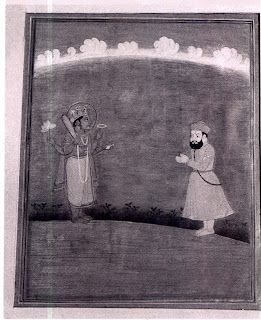
The contentious painting, executed by a Pahari painter in the mid-19th century (whose name, as often in folk art, remains unknown), shows a topi-wearing Guru Nanak praying to Lord Vishnu. The Board took the Sikh-separatist line that that Sikhism has nothing to do with Hinduism, and that the Gurus are above the “Brahminical” gods. It is the same line that keeps the Sikh establishment from calling their central shrine, the Hari Mandir (“Vishnu temple”), by its proper name, hiding it behind the superficial designation “Golden Temple” or the Moghul term “Darbar Sahib”. It is also why in 1922 they threw out from the Hari Mandir the murti-s that had been worshipped there ever since Arjan Dev inaugurated it in 1604. Sikh identity as a separate religion, rather than as one of the many panth-s in the Hindu commonwealth, is based on a denial of history, and this requires a constant censoring of unwilling historical data: names changed, scriptures doctored, murti-s thrown away, the publication of a painting suppressed.

K.C. Aryan donated the painting in ca. 1982 to the Himachal State Museum in Shimla. There, it is significantly not on display but kept in storage. That is, if it has not been lost or illegally sold by some babu unconcerned with art and heritage; or somehow eliminated by one with Khalistani.leanings eager to destroy the evidence for an inconvenient fact: that Guru Nanak was every inch a Hindu.

Read more in Dr. Koenraad Elst’s book: http://koenraadelst.bharatvani.org/books/wiah/ch8.htm

Guru Nanak obviously did use the word ‘Hari’ to refer to God, but he also used the word ‘Allah’ and ‘Ishvara’ and if Christianity had been in India at the time, he would have used their words to. In the Moola Mantra it says that no names are enough to describe the glory of god. This is why Guru Nanak said chant the words the ‘true name’ itself(Sat Naam), not any particular name.

The same concept is present here as Nirguna Brahman and Sadguna Brahman. There is only one Nirguna Brahaman, but infinite Sadguna Brahmans. All Sadguna Brahmans are limited descriptions: God as Vishnu, God as Shiva; God as Nature; God as animal; God as friend; god as father. Nirguna Brahman is beyond any description. Nonetheless some words are used to help us hold that concept in our mind like Sat, Chit, Ananda. That Nirguna Brahman is Truth, is Love and Bliss and Pure consciousness.

The worship of Nirguna Brahman is emphasized in Sikhism and the practice of making images of Brahman is discouraged. Everytime we make an image of god, we limit god.

The evidence lies in front of you, the Sikhs were also idol worshippers before the khalistani separists tried to destroy all Hindu elements from the sect. There were actual murtis of Hindu Gods in the Golden Temple (hari mandir) before the khalistani removed them in the 20th century, there would be no need to build a temple for an impersonal god.

Even the Hindu gods are described in the Sikh texts with both saguna and nirguna. Not very different from how Hindu saints Tulasi Dasa described the deities with both Nirguna and Saguna.

ਕਾਰਨ ਈਸ ਕਲਾ ਕਮਲਾ ਹਰਿ ਅਦ੍ਰਸੁਤਾ ਜਹ ਦੇਖੇ ਉਹੀ ਹੈ ॥
Kaaran oos kalaa kamlaa har(i) adrasutaa jah dekhe uhoo hai||
Thou art the cause of the Shakti of Shiva, Lakshmi of Vishnu and Parvati, the daughter of Himavan, wherever we see, Thou art there.
~Shri Dasam Granth Sahib Ji p. 176

ਸ੍ਰੀ ਰਾਮਚੰਦ ਜਿਸੁ ਰੂਪੁ ਨ ਰੇਖਿਆ ॥
sree raamachandh jis roop n raekhiaa ||
You are the Great Raam Chand, who has no form or feature.

ਬਨਵਾਲੀ ਚਕ੍ਰਪਾਣਿ ਦਰਸਿ ਅਨੂਪਿਆ ॥
banavaalee chakrapaan dharas anoopiaa ||
Adorned with flowers, holding the chakra in Your hand, Your form is incomparably beautiful.

ਸਹਸ ਨੇਤ੍ਰ ਮੂਰਤਿ ਹੈ ਸਹਸਾ ਇਕੁ ਦਾਤਾ ਸਭ ਹੈ ਮੰਗਾ ॥੪॥
sehas naethr moorath hai sehasaa eik dhaathaa sabh hai mangaa ||4||
You have thousands of eyes, and thousands of forms. You alone are the Giver, and all are beggars of You. ||4||

ਭਗਤਿ ਵਛਲੁ ਅਨਾਥਹ ਨਾਥੇ ॥
bhagath vashhal anaathheh naathhae ||
You are the Lover of Your devotees, the Master of the masterless.

ਗੋਪੀ ਨਾਥੁ ਸਗਲ ਹੈ ਸਾਥੇ ॥
gopee naathh sagal hai saathhae ||
The Lord and Master of the milk-maids, You are the companion of all.

ਬਾਸੁਦੇਵ ਨਿਰੰਜਨ ਦਾਤੇ ਬਰਨਿ ਨ ਸਾਕਉ ਗੁਣ ਅੰਗਾ ॥੫॥
baasudhaev niranjan dhaathae baran n saako gun angaa ||5||
O Lord, Immacuate Great Giver, I cannot describe even an iota of Your Glorious Virtues. ||5||

ਮੁਕੰਦ ਮਨੋਹਰ ਲਖਮੀ ਨਾਰਾਇਣ ॥
mukandh manohar lakhamee naaraaein ||
Liberator, Enticing Lord, Lord of Lakshmi, Supreme Lord God.

ਦ੍ਰੋਪਤੀ ਲਜਾ ਨਿਵਾਰਿ ਉਧਾਰਣ ॥
dhropathee lajaa nivaar oudhhaaran ||
Savior of Dropadi’s honor.

ਕਮਲਾਕੰਤ ਕਰਹਿ ਕੰਤੂਹਲ ਅਨਦ ਬਿਨੋਦੀ ਨਿਹਸੰਗਾ ॥੬॥
kamalaakanth karehi kanthoohal anadh binodhee nihasangaa ||6||
Lord of Maya, miracle-worker, absorbed in delightful play, unattached. ||6||

ਅਮੋਘ ਦਰਸਨ ਆਜੂਨੀ ਸੰਭਉ ॥
amogh dharasan aajoonee sanbho ||
The Blessed Vision of His Darshan is fruitful and rewarding; He is not born, He is self-existent.

ਅਕਾਲ ਮੂਰਤਿ ਜਿਸੁ ਕਦੇ ਨਾਹੀ ਖਉ ॥
akaal moorath jis kadhae naahee kho ||
His form is undying; it is never destroyed.

ਅਬਿਨਾਸੀ ਅਬਿਗਤ ਅਗੋਚਰ ਸਭੁ ਕਿਛੁ ਤੁਝ ਹੀ ਹੈ ਲਗਾ ॥੭॥
abinaasee abigath agochar sabh kishh thujh hee hai lagaa ||7||
O imperishable, eternal, unfathomable Lord, everything is attached to You.

ਸ੍ਰੀਰੰਗ ਬੈਕੁੰਠ ਕੇ ਵਾਸੀ ॥
sreerang baikunth kae vaasee ||
The Lover of greatness, who dwells in heaven.
~Shri Guru Granth Sahib Ji p. 1082

ਮਛੁ ਕਛੁ ਕੂਰਮੁ ਆਗਿਆ ਅਉਤਰਾਸੀ ॥
मछु कछु कूरमु आगिआ अउतरासी ॥
Macẖẖ kacẖẖ kūram āgi▫ā a▫uṯrāsī.
By the Pleasure of His Will, He took incarnation as the great fish and the tortoise.

ਕੇਸਵ ਚਲਤ ਕਰਹਿ ਨਿਰਾਲੇ ਕੀਤਾ ਲੋੜਹਿ ਸੋ ਹੋਇਗਾ ॥੮॥
केसव चलत करहि निराले कीता लोड़हि सो होइगा ॥८॥
Kesav cẖalaṯ karahi nirāle kīṯā loṛėh so ho▫igā. ||8||
Keshav, the Lord of beauteous hair, the Worker of miraculous deeds, whatever He wishes, comes to pass. ||8||

ਨਿਰਾਹਾਰੀ ਨਿਰਵੈਰੁ ਸਮਾਇਆ ॥
निराहारी निरवैरु समाइआ ॥
Nirāhārī nirvair samā▫i▫ā.
He is beyond need of any sustenance, free of hate and all-pervading.

ਧਾਰਿ ਖੇਲੁ ਚਤੁਰਭੁਜੁ ਕਹਾਇਆ ॥
धारि खेलु चतुरभुजु कहाइआ ॥
Ḏẖār kẖel cẖaṯurbẖuj kahā▫i▫ā.
He has staged His play; He is called the four-armed Lord (Chaturbhuja).

ਸਾਵਲ ਸੁੰਦਰ ਰੂਪ ਬਣਾਵਹਿ ਬੇਣੁ ਸੁਨਤ ਸਭ ਮੋਹੈਗਾ ॥੯॥
सावल सुंदर रूप बणावहि बेणु सुनत सभ मोहैगा ॥९॥
Sāval sunḏar rūp baṇāvėh beṇ sunaṯ sabẖ mohaigā. ||9||
He is the beautiful blue-skinned Krishna; hearing His flute, all are fascinated and enticed. ||9||

ਬਨਮਾਲਾ ਬਿਭੂਖਨ ਕਮਲ ਨੈਨ ॥
बनमाला बिभूखन कमल नैन ॥
Banmālā bibẖūkẖan kamal nain.
He is adorned with garlands of flowers, with lotus eyes (Kamal Nayan).

ਸੁੰਦਰ ਕੁੰਡਲ ਮੁਕਟ ਬੈਨ ॥
सुंदर कुंडल मुकट बैन ॥
Sunḏar kundal mukat bain.
His ear-rings, crown and flute are so beautiful.

ਸੰਖ ਚਕ੍ਰ ਗਦਾ ਹੈ ਧਾਰੀ ਮਹਾ ਸਾਰਥੀ ਸਤਸੰਗਾ ॥੧੦॥
संख चक्र गदा है धारी महा सारथी सतसंगा ॥१०॥
Sankẖ cẖakar gaḏā hai ḏẖārī mahā sārthī saṯsangā. ||10||
He carries the conch, the chakra and the war club; He is the Great Charioteer, who stays with His Saints. ||10||

ਪੀਤ ਪੀਤੰਬਰ ਤ੍ਰਿਭਵਣ ਧਣੀ ॥
पीत पीत्मबर त्रिभवण धणी ॥
Pīṯ pīṯambar ṯaribẖavaṇ ḏẖaṇī.
The Lord of yellow robes, the Master of the three worlds.

जगंनाथु गोपालु मुखि भणी ॥
Jagannāth gopāl mukẖ bẖaṇī.
Jagannath, the Lord of the Universe, Gopal, the protector of cows; with my mouth, I chant His Name.

ਸਾਰਿੰਗਧਰ ਭਗਵਾਨ ਬੀਠੁਲਾ ਮੈ ਗਣਤ ਨ ਆਵੈ ਸਰਬੰਗਾ ॥੧੧॥
सारिंगधर भगवान बीठुला मै गणत न आवै सरबंगा ॥११॥
Sāringḏẖar bẖagvān bīṯẖulā mai gaṇaṯ na āvai sarbangā. ||11||
Saringdhar, the bearer of Saranga bow, the Beloved Lord God; I cannot count all His limbs. ||11||

ਨਿਹਕੰਟਕੁ ਨਿਹਕੇਵਲੁ ਕਹੀਐ ॥
निहकंटकु निहकेवलु कहीऐ ॥
Nihkantak nihkeval kahī▫ai.
He is said to be free of anguish, and absolutely immaculate.

ਧਨੰਜੈ ਜਲਿ ਥਲਿ ਹੈ ਮਹੀਐ ॥
धनंजै जलि थलि है महीऐ ॥
Ḏẖananjai jal thal hai mahī▫ai.
Dhananjai, the Victor of Wealth, pervading the water, the land and the sky.

ਆਪੇ ਸਿਵ ਵਰਤਾਈਅਨੁ ਅੰਤਰਿ ਆਪੇ ਸੀਤਲੁ ਠਾਰੁ ਗੜਾ ॥੧੩॥
आपे सिव वरताईअनु अंतरि आपे सीतलु ठारु गड़ा ॥१३॥
Āpe siv varṯā▫ī▫an anṯar āpe sīṯal ṯẖār gaṛā. ||13||
You are Shiva; You are cool and icy calm. ||13||

ਤਿਸ ਹੀ ਸੁਖੁ ਤਿਸ ਹੀ ਠਕੁਰਾਈ ਤਿਸਹਿ ਨ ਆਵੈ ਜਮੁ ਨੇੜਾ ॥੧੪॥
तिस ही सुखु तिस ही ठकुराई तिसहि न आवै जमु नेड़ा ॥१४॥
Ŧis hī sukẖ ṯis hī ṯẖakurā▫ī ṯisėh na āvai jam neṛā. ||14||
He is peaceful, and he is the master of all; the Messenger of Death does not even approach him. ||14||

ਕੀਮਤਿ ਕਾਗਦ ਕਹੀ ਨ ਜਾਈ ॥
कीमति कागद कही न जाई ॥
Kīmaṯ kāgaḏ kahī na jā▫ī.
His value cannot be described on paper.
ਕਹੁ ਨਾਨਕ ਬੇਅੰਤ ਗੁਸਾਈ ॥
कहु नानक बेअंत गुसाई ॥
Kaho Nānak be▫anṯ gusā▫ī.
Says Nanak, Lord Gosayee is infinite.

ਆਦਿ ਮਧਿ ਅੰਤਿ ਪ੍ਰਭੁ ਸੋਈ ਹਾਥਿ ਤਿਸੈ ਕੈ ਨੇਬੇੜਾ ॥੧੫॥
आदि मधि अंति प्रभु सोई हाथि तिसै कै नेबेड़ा ॥१५॥
Āḏ maḏẖ anṯ parabẖ so▫ī hāth ṯisai kai nebeṛā. ||15||
In the beginning, in the middle and in the end, God exists. judgment is in His Hands alone. ||15||

ਤਿਸਹਿ ਸਰੀਕੁ ਨਾਹੀ ਰੇ ਕੋਈ ॥
तिसहि सरीकु नाही रे कोई ॥
Ŧisėh sarīk nāhī re ko▫ī.
No one is equal to Him.

ਕਿਸ ਹੀ ਬੁਤੈ ਜਬਾਬੁ ਨ ਹੋਈ ॥
किस ही बुतै जबाबु न होई ॥
Kis hī buṯai jabāb na ho▫ī.
No one can stand up against Him by any means.

ਨਾਨਕ ਕਾ ਪ੍ਰਭੁ ਆਪੇ ਆਪੇ ਕਰਿ ਕਰਿ ਵੇਖੈ ਚੋਜ ਖੜਾ ॥੧੬॥੧॥੧੦॥
नानक का प्रभु आपे आपे करि करि वेखै चोज खड़ा ॥१६॥१॥१०॥
Nānak kā parabẖ āpe āpe kar kar vekẖai cẖoj kẖaṛā. ||16||1||10||
Nanak’s God is Himself all-in-all. He creates and stages and watches His wondrous plays. ||16||1||10||

ਮਾਰੂ ਮਹਲਾ ੫ ॥
मारू महला ५ ॥
Mārū mėhlā 5.
Maaroo, Fifth Mehl:

ਅਚੁਤ ਪਾਰਬ੍ਰਹਮ ਪਰਮੇਸੁਰ ਅੰਤਰਜਾਮੀ ॥
अचुत पारब्रहम परमेसुर अंतरजामी ॥
Acẖuṯ pārbarahm parmesur anṯarjāmī.
Achyuth is imperishable, Parabrahman, Parameshwar and Antaryaami.

ਮਧੁਸੂਦਨ ਦਾਮੋਦਰ ਸੁਆਮੀ ॥
मधुसूदन दामोदर सुआमी ॥
Maḏẖusūḏan ḏāmoḏar su▫āmī.
He is Madhusudhan, our Supreme Lord and Master Damodhar.

ਰਿਖੀਕੇਸ ਗੋਵਰਧਨ ਧਾਰੀ ਮੁਰਲੀ ਮਨੋਹਰ ਹਰਿ ਰੰਗਾ ॥੧॥
रिखीकेस गोवरधन धारी मुरली मनोहर हरि रंगा ॥१॥
Rikẖīkes govarḏẖan ḏẖārī murlī manohar har rangā. ||1||
Hrishikesh, The Supreme Rishi, the uplifter of Govardhan, the joyful Lord Monohar Hari playing His enticing flute. ||1||

ਮੋਹਨ ਮਾਧਵ ਕ੍ਰਿਸ੍ਨ ਮੁਰਾਰੇ ॥
मोहन माधव क्रिस्न मुरारे ॥
Mohan māḏẖav krisan murāre.
Mohan, the Enticer of Hearts , Madhav, Krishna, abd Murari, the Enemy of ego.

ਜਗਦੀਸੁਰ ਹਰਿ ਜੀਉ ਅਸੁਰ ਸੰਘਾਰੇ ॥
जगदीसुर हरि जीउ असुर संघारे ॥
Jagḏīsur har jī▫o asur sangẖāre.
Jagdish the Lord of the Universe, Hari, the Dear Lord, the Destroyer of demons.

ਜਗਜੀਵਨ ਅਬਿਨਾਸੀ ਠਾਕੁਰ ਘਟ ਘਟ ਵਾਸੀ ਹੈ ਸੰਗਾ ॥੨॥
जगजीवन अबिनासी ठाकुर घट घट वासी है संगा ॥२॥
Jagjīvan abẖināsī ṯẖākur gẖat gẖat vāsī hai sangā. ||2||
The Life of the World, our eternal and ever-stable Lord and Master dwells within each and every heart, and is always with us. ||2||

ਧਰਣੀਧਰ ਈਸ ਨਰਸਿੰਘ ਨਾਰਾਇਣ ॥
धरणीधर ईस नरसिंघ नाराइण ॥
Ḏẖarṇīḏẖar īs narsingẖ nārā▫iṇ.
Dharnidhar, the Supporter of the Earth, Narsingh, the man-lion and Narayan, the Supreme Lord God.

ਦਾੜਾ ਅਗ੍ਰੇ ਪ੍ਰਿਥਮਿ ਧਰਾਇਣ ॥
दाड़ा अग्रे प्रिथमि धराइण ॥
Ḏāṛā agre paritham ḏẖarā▫iṇ.
The Protector who tears apart demons with His teeth, the Upholder of the earth.

ਬਾਵਨ ਰੂਪੁ ਕੀਆ ਤੁਧੁ ਕਰਤੇ ਸਭ ਹੀ ਸੇਤੀ ਹੈ ਚੰਗਾ ॥੩॥
बावन रूपु कीआ तुधु करते सभ ही सेती है चंगा ॥३॥
Bāvan rūp kī▫ā ṯuḏẖ karṯe sabẖ hī seṯī hai cẖanga. ||3||
O Creator, You assumed the form of the pygmy to humble the demons; You are the Lord God of all. ||3||

ਸ੍ਰੀ ਰਾਮਚੰਦ ਜਿਸੁ ਰੂਪੁ ਨ ਰੇਖਿਆ ॥
स्री रामचंद जिसु रूपु न रेखिआ ॥
Sarī rāmcẖanḏ jis rūp na rekẖ▫i▫ā.
You are the Great Raam Chand, who has no form or feature.

ਬਨਵਾਲੀ ਚਕ੍ਰਪਾਣਿ ਦਰਸਿ ਅਨੂਪਿਆ ॥
बनवाली चक्रपाणि दरसि अनूपिआ ॥
Banvālī cẖakarpāṇ ḏaras anūpi▫ā.
Adorned with flowers, holding the chakra in Your hand, Your form is incomparably beautiful.

ਸਹਸ ਨੇਤ੍ਰ ਮੂਰਤਿ ਹੈ ਸਹਸਾ ਇਕੁ ਦਾਤਾ ਸਭ ਹੈ ਮੰਗਾ ॥੪॥
सहस नेत्र मूरति है सहसा इकु दाता सभ है मंगा ॥४॥
Sahas neṯar mūraṯ hai sahsā ik ḏāṯā sabẖ hai mangā. ||4||
You have thousands of eyes, and thousands of forms. You alone are the Giver, and all are beggars of You. ||4||

ਭਗਤਿ ਵਛਲੁ ਅਨਾਥਹ ਨਾਥੇ ॥
भगति वछलु अनाथह नाथे ॥
Bẖagaṯ vacẖẖal anāthah nāthe.
You are Bhktavtsal (Bhagtvachhal), the Lover of Your devotees, the Master of the masterless.

ਗੋਪੀ ਨਾਥੁ ਸਗਲ ਹੈ ਸਾਥੇ ॥
गोपी नाथु सगल है साथे ॥
Gopī nāth sagal hai sāthe.
Gopinaath, The Lord and Master of the milk-maids, You are the companion of all.

ਬਾਸੁਦੇਵ ਨਿਰੰਜਨ ਦਾਤੇ ਬਰਨਿ ਨ ਸਾਕਉ ਗੁਣ ਅੰਗਾ ॥੫॥
बासुदेव निरंजन दाते बरनि न साकउ गुण अंगा ॥५॥
Bāsuḏev niranjan ḏāṯe baran na sāka▫o guṇ angā. ||5||
O Basudev, Immaculate Great Giver, I cannot describe even an iota of Your Glorious Virtues. ||5||

ਮੁਕੰਦ ਮਨੋਹਰ ਲਖਮੀ ਨਾਰਾਇਣ ॥
मुकंद मनोहर लखमी नाराइण ॥
Mukanḏ manohar lakẖmī nārā▫iṇ.
Mukund, Liberator, Manohar, Enticing Lord and Lakshmi Narain, Lord of Lakshmi, Supreme Lord God.

ਦ੍ਰੋਪਤੀ ਲਜਾ ਨਿਵਾਰਿ ਉਧਾਰਣ ॥
द्रोपती लजा निवारि उधारण ॥
Ḏaropaṯī lajā nivār uḏẖāraṇ.
Savior of Dropadi’s honor.

ਕਮਲਾਕੰਤ ਕਰਹਿ ਕੰਤੂਹਲ ਅਨਦ ਬਿਨੋਦੀ ਨਿਹਸੰਗਾ ॥੬॥
कमलाकंत करहि कंतूहल अनद बिनोदी निहसंगा ॥६॥
Kamlākanṯ karahi kanṯūhal anaḏ binoḏī nihsangā. ||6||
Kamalakant, Lord of Lakshmi, miracle-worker, absorbed in delightful play, unattached. ||6||

ਅਮੋਘ ਦਰਸਨ ਆਜੂਨੀ ਸੰਭਉ ॥
अमोघ दरसन आजूनी स्मभउ ॥
Amogẖ ḏarsan ājūnī sambẖa▫o.
The Blessed Vision of His Darshan is fruitful and rewarding; He is not born, He is self-existent.

ਅਕਾਲ ਮੂਰਤਿ ਜਿਸੁ ਕਦੇ ਨਾਹੀ ਖਉ ॥
अकाल मूरति जिसु कदे नाही खउ ॥
Akāl mūraṯ jis kaḏe nāhī kẖa▫o.
His form is undying; it is never destroyed.

ਅਬਿਨਾਸੀ ਅਬਿਗਤ ਅਗੋਚਰ ਸਭੁ ਕਿਛੁ ਤੁਝ ਹੀ ਹੈ ਲਗਾ ॥੭॥
अबिनासी अबिगत अगोचर सभु किछु तुझ ही है लगा ॥७॥
Abẖināsī abigaṯ agocẖar sabẖ kicẖẖ ṯujẖ hī hai lagā. ||7||
O Avinashi, imperishable, Abigat, eternal, Agochar, unfathomable Lord, everything is attached to You. ||7||

ਸ੍ਰੀਰੰਗ ਬੈਕੁੰਠ ਕੇ ਵਾਸੀ ॥
स्रीरंग बैकुंठ के वासी ॥
Sarīrang baikunṯẖ ke vāsī.
Shriranga, The Lover of greatness, who dwells in Vaikunta.

ਮਛੁ ਕਛੁ ਕੂਰਮੁ ਆਗਿਆ ਅਉਤਰਾਸੀ ॥
मछु कछु कूरमु आगिआ अउतरासी ॥
Macẖẖ kacẖẖ kūram āgi▫ā a▫uṯrāsī.
By the Pleasure of His Will, He took incarnation as the great fish and the tortoise.

ਕੇਸਵ ਚਲਤ ਕਰਹਿ ਨਿਰਾਲੇ ਕੀਤਾ ਲੋੜਹਿ ਸੋ ਹੋਇਗਾ ॥੮॥
केसव चलत करहि निराले कीता लोड़हि सो होइगा ॥८॥
Kesav cẖalaṯ karahi nirāle kīṯā loṛėh so ho▫igā. ||8||
Keshav, the Lord of beauteous hair, the Worker of miraculous deeds, whatever He wishes, comes to pass. ||8||

ਨਿਰਾਹਾਰੀ ਨਿਰਵੈਰੁ ਸਮਾਇਆ ॥
निराहारी निरवैरु समाइआ ॥
Nirāhārī nirvair samā▫i▫ā.
He is beyond need of any sustenance, free of hate and all-pervading.

ਧਾਰਿ ਖੇਲੁ ਚਤੁਰਭੁਜੁ ਕਹਾਇਆ ॥
धारि खेलु चतुरभुजु कहाइआ ॥
Ḏẖār kẖel cẖaṯurbẖuj kahā▫i▫ā.
He has staged His play; He is called the four-armed Lord (Chaturbhuja).

ਸਾਵਲ ਸੁੰਦਰ ਰੂਪ ਬਣਾਵਹਿ ਬੇਣੁ ਸੁਨਤ ਸਭ ਮੋਹੈਗਾ ॥੯॥
सावल सुंदर रूप बणावहि बेणु सुनत सभ मोहैगा ॥९॥
Sāval sunḏar rūp baṇāvėh beṇ sunaṯ sabẖ mohaigā. ||9||
He is the beautiful blue-skinned Krishna; hearing His flute, all are fascinated and enticed. ||9||

ਬਨਮਾਲਾ ਬਿਭੂਖਨ ਕਮਲ ਨੈਨ ॥
बनमाला बिभूखन कमल नैन ॥
Banmālā bibẖūkẖan kamal nain.
He is adorned with garlands of flowers, with lotus eyes (Kamal Nayan).

ਸੁੰਦਰ ਕੁੰਡਲ ਮੁਕਟ ਬੈਨ ॥
सुंदर कुंडल मुकट बैन ॥
Sunḏar kundal mukat bain.
His ear-rings, crown and flute are so beautiful.

ਸੰਖ ਚਕ੍ਰ ਗਦਾ ਹੈ ਧਾਰੀ ਮਹਾ ਸਾਰਥੀ ਸਤਸੰਗਾ ॥੧੦॥
संख चक्र गदा है धारी महा सारथी सतसंगा ॥१०॥
Sankẖ cẖakar gaḏā hai ḏẖārī mahā sārthī saṯsangā. ||10||
He carries the conch, the chakra and the war club; He is the Great Charioteer, who stays with His Saints. ||10||

ਪੀਤ ਪੀਤੰਬਰ ਤ੍ਰਿਭਵਣ ਧਣੀ ॥
पीत पीत्मबर त्रिभवण धणी ॥
Pīṯ pīṯambar ṯaribẖavaṇ ḏẖaṇī.
The Lord of yellow robes, the Master of the three worlds.

जगंनाथु गोपालु मुखि भणी ॥
Jagannāth gopāl mukẖ bẖaṇī.
Jagannath, the Lord of the Universe, Gopal, the protector of cows; with my mouth, I chant His Name.

ਸਾਰਿੰਗਧਰ ਭਗਵਾਨ ਬੀਠੁਲਾ ਮੈ ਗਣਤ ਨ ਆਵੈ ਸਰਬੰਗਾ ॥੧੧॥
सारिंगधर भगवान बीठुला मै गणत न आवै सरबंगा ॥११॥
Sāringḏẖar bẖagvān bīṯẖulā mai gaṇaṯ na āvai sarbangā. ||11||
Saringdhar, the bearer of Saranga bow, the Beloved Lord God; I cannot count all His limbs. ||11||

ਨਿਹਕੰਟਕੁ ਨਿਹਕੇਵਲੁ ਕਹੀਐ ॥
निहकंटकु निहकेवलु कहीऐ ॥
Nihkantak nihkeval kahī▫ai.
He is said to be free of anguish, and absolutely immaculate.

ਧਨੰਜੈ ਜਲਿ ਥਲਿ ਹੈ ਮਹੀਐ ॥
धनंजै जलि थलि है महीऐ ॥
Ḏẖananjai jal thal hai mahī▫ai.
Dhananjai, the Victor of Wealth, pervading the water, the land and the sky.

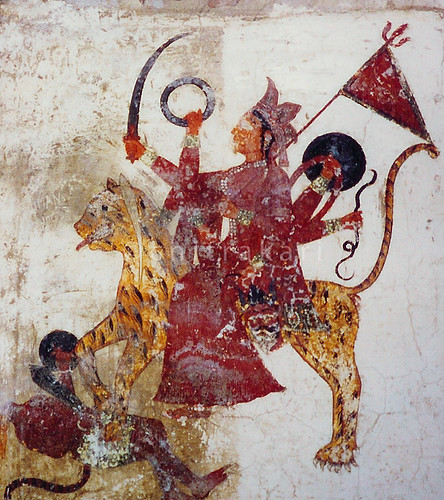
Fresco depicting a scene from Markandey Puraan where Durga crushes Mahikasur (a demon), at the Guru Ram Rai Udasin Akhara at Dehradun, Uttranchal, India
Vedanta have the best approach to worshiping Nirguna Brahman: the worship of the Self. Swami Vivekananda said, “The true atheist is one who does not believe in themselves” The Self is something highly abstract and transcendental, and yet it is also an immanent reality to us and we experience it every moment. So why complicate something so simple by creating countless images, when all we need to do is just enter into ourselves.

The difference between a spiritual and religious person can thus be defined: a religious person worships Sadguna Brahman - images of god; a spiritual person worships Nirguna Brahman - god as felt and sensed every moment. A religious person needs to go to temples and worship a statue, or consult a priest to put them in touch with god ; a spiritual person meditates and communes with god directly.

The evidence lies in front of you, the Sikhs were also idol worshippers in the, even the Hindu gods are described in the Sikh texts.

No they were not, idol worship is not a practice given in any Sikh scripture. Guru Nanak spoke up against this practice, he never endorsed it. The Sikh scriptures only uses the terminology and symbols current with the people at the time. Not just Hindu ones, but also Muslim ones, because Muslims were a part of Indian society as well then.